Physical Address
304 North Cardinal St.
Dorchester Center, MA 02124
Physical Address
304 North Cardinal St.
Dorchester Center, MA 02124

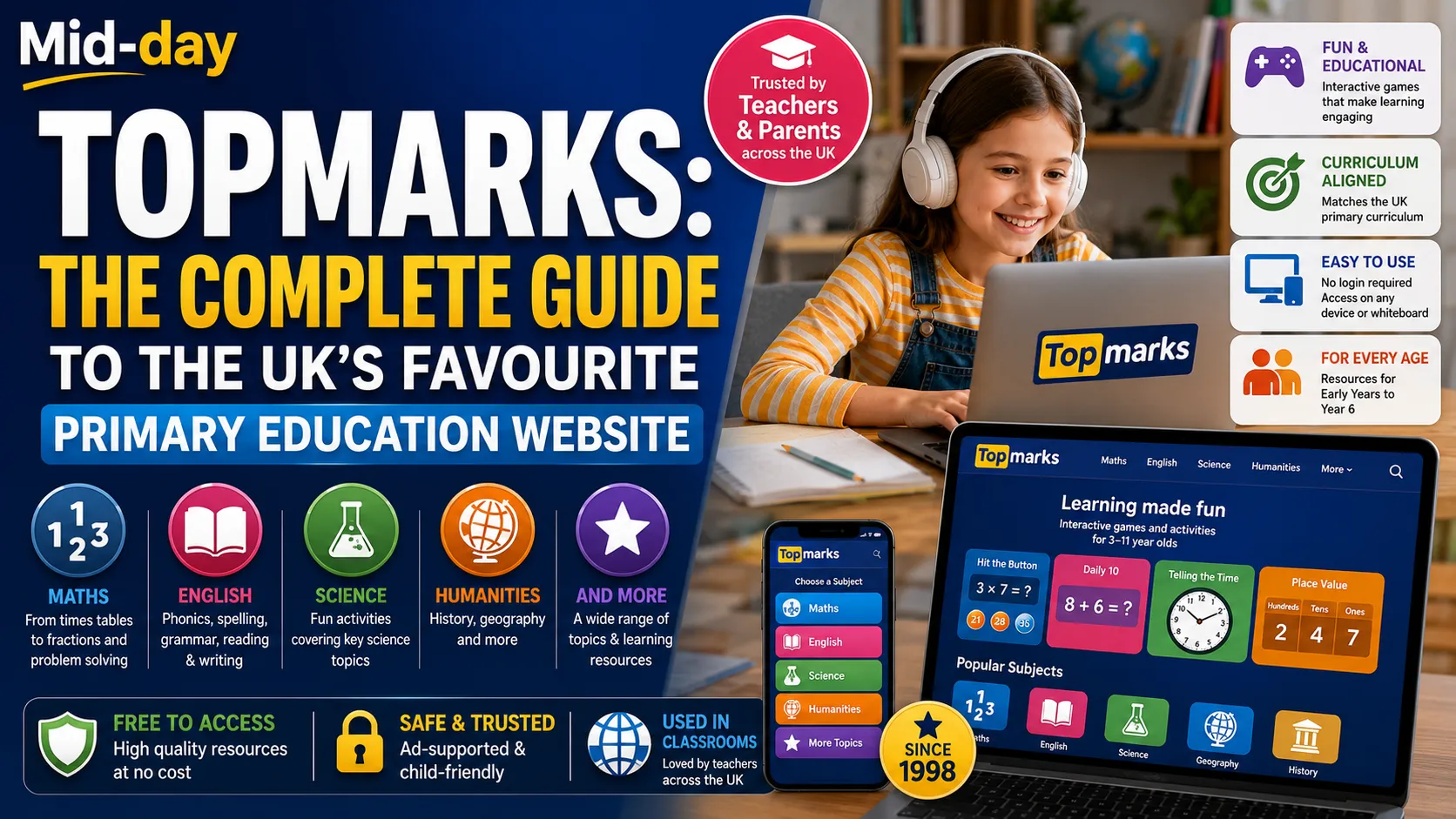
If you have a child in primary school in the UK, or if you teach Key Stage 1 or Key Stage 2, you have almost certainly come across Topmarks. It is one of the most established free educational websites used in British classrooms and homes, providing games, activities, and interactive resources for children from early years through to the end of year 6. Unlike many educational sites that have drifted toward subscription models or have been acquired and changed beyond recognition, Topmarks has maintained its core offer: free, curriculum-aligned, browser-based educational content that just works.
This guide covers what Topmarks is, who it is for, how to use it effectively for different year groups and subjects, and which resources teachers and parents get the most value from.
Topmarks is a free educational website based in the UK, providing interactive games, activities, and teaching resources for children aged 3 to 14, with a particular focus on the primary school age range. It is accessible at topmarks.co.uk and requires no registration or login for basic use.
The site curates and creates interactive HTML5-based games and activities across the core primary curriculum subjects: math, English (literacy), science, and humanities. Resources are organized by subject, age range, and topic, making it straightforward to find something specific for a particular year group’s current unit of study.
Topmarks is used both in classrooms, where teachers display activities on an interactive whiteboard or set them as self-directed tasks on individual devices, and at home, where parents use the site to support their child’s learning outside school hours.
Topmarks was founded by David Millward and has operated as an independent UK educational website since 1998, making it one of the longest-running educational web resources in the country. Its longevity is partly explained by its model: it does not rely on venture capital, does not lock content behind paywalls for the features most used by teachers, and has continued to update its technical infrastructure from older Flash-based content to modern HTML5 as browser standards evolved.
The site generates revenue through advertising displayed to adult users and through a premium section for schools while keeping the main catalog of games and activities freely accessible without registration.
Math is the most heavily used subject area on Topmarks for most teachers and parents. The site provides interactive games covering the full range of primary math topics.
Some of the most widely used and searched Topmarks math resources include:
Hit the Button: One of the most popular primary math games in UK schools. It provides rapid-fire mental math practice for times tables, division facts, number bonds, halving, and doubling. Players answer as many questions as possible within 60 seconds. The game is widely used as a starter activity and for timed practice of specific fact families. Hit the Button is accessible directly at topmarks.co.uk/maths-games/hit-the-button.
Daily 10: A structured mental math challenge designed for use on an interactive whiteboard with a whole class. It generates ten random questions on a selected topic at a selected difficulty level corresponding to Year 1 through Year 6. Questions are displayed one at a time with configurable timing. Topics include addition, subtraction, multiplication, division, place value, fractions, rounding, and ordering. Daily 10 is at topmarks.co.uk/maths-games/daily10.
Telling the Time: Multiple interactive clock activities for different levels of difficulty, from reading hours to reading minutes on analog and digital clocks.
Place Value Chart: An interactive chart for exploring how numbers are structured in the base-10 system.
Mental Math Train: An activity that reinforces core mental math facts through a game format.
Coconut Multiples: A multiplication and factor recognition game.
Other math topics covered include shape and space, data handling, fractions and decimals, negative numbers, and coordinates.
The English section of Topmarks covers reading, writing, grammar, spelling, and phonics. Key resources include the following:
Phonics activities: Suitable for Early Years and Year 1 children working through the phases of systematic synthetic phonics, covering letter sounds, blending, segmenting, and tricky words.
Grammar games: Interactive activities covering punctuation, word types (nouns, verbs, adjectives, adverbs), sentence construction, and connectives aligned to the KS1 and KS2 grammar requirements of the National Curriculum.
Spelling: Activities targeting common exception words, spelling rules, and the Year 3 and 4 or Year 5 and 6 statutory spelling word lists.
Science resources on Topmarks cover the primary science curriculum topics, including animals and their habitats, the human body, plants, materials, states of matter, forces, light, sound, Earth and space, and electricity. Activities tend to be interactive drag-and-drop or quiz formats rather than games.
History, geography, and other subjects are covered less comprehensively than math and English, but the site includes activities for topic work. Topmarks also provides a resource finder that links outward to other reputable educational websites for subjects where its own collection is thinner.
Topmarks organizes its content in two ways: by subject and by age range. When you click on a subject area (such as math), you can then filter by age or year group. Resources are typically tagged as suitable for age ranges including 3-5 (early years), 5-7 (KS1, years 1 and 2), 7-11 (KS2, years 3 through 6), and 11-14 (KS3).
The most efficient route for a teacher or parent is the following:
Beyond its own games, Topmarks operates a curated resource finder that lists links to external educational websites organized by subject and topic. This is a useful signposting tool when Topmarks does not have its own game for a specific topic, since the external links are checked for quality and curriculum relevance before being included.
Many Topmarks games were designed specifically for whole-class interactive whiteboard use. Daily 10, for example, is most naturally used with a class answering on whiteboards, slates, or notebooks while the teacher controls the pace on screen. Hit the Button works on individual devices but also works for whole-class timed challenge sessions projected on a whiteboard.
HTML5 games work in modern browsers on Chromebooks, iPads, Windows laptops, and desktop computers without any plugin installation.
Daily 10 and Hit the Button are the two resources most consistently used by UK primary teachers as short starter activities at the beginning of maths lessons. A five-minute Hit the Button session targeting the times tables currently being studied, or a Daily 10 set at the appropriate year-group level, warms up mental calculation before the main lesson begins.
Topmarks games work well on individual devices during guided reading or independent practice time. While one group works with the teacher, another group can work on Topmarks activities targeted at their current math or English focus. Because the games require no login or account management, they can be used spontaneously without advance setup.
Because Topmarks is free and requires no account, it is easy for teachers to recommend specific games for home practice without parents needing to sign up for anything. Sharing a direct URL to Hit the Button or Daily 10 in a class newsletter or via the school’s communication app (such as EduLink One or Class Dojo) is straightforward.
Some teachers run a daily 10 or similar activity as children arrive in the morning, giving early finishers or arriving pupils something structured to engage with before the formal start of the day.
The most practical use of Topmarks for parents is as a supplement to school math, particularly for times tables practice. Hit the Button allows specific times tables or division fact families to be selected, which means you can target exactly what your child is currently working on at school rather than practicing randomly.
A realistic home routine for using TopMarks effectively is
For younger children in Reception or Year 1, the phonics and early number activities are well-suited to a five-minute session before or after dinner, particularly for children who enjoy screen-based activities and respond better to game formats than to printed worksheets.
A few observations explain why Topmarks has continued to be used by UK teachers and parents for nearly three decades when so many comparable educational websites have come and gone.
It has no friction. Opening a browser, going to topmarks.co.uk, and starting a game takes approximately fifteen seconds. There is no login, no loading spinner while an account syncs, no age verification, and no upsell pop-up before the content loads. This zero-friction model means teachers will actually use it in a lesson rather than abandoning the idea because the setup is too slow.
The HTML5 migration kept it functional. Many educational websites that were built on Flash content stopped working when browsers removed Flash support in 2020. Topmarks invested in rewriting its core resources in HTML5, which means the games continue to work on modern school Chromebooks, iPads, and Windows devices without any additional software.
Its curriculum alignment has remained current. The most-used Topmarks games reflect the specific content of England’s National Curriculum for primary math and English. Daily 10’s level structure maps directly to year group expectations, and Hit the Button’s fact families align with the multiplication tables check requirements. This means teachers can use the resources with confidence that the content matches what they are teaching.
The community of practice around it keeps it visible. UK teacher communities on social media, particularly Twitter and Facebook groups for primary math, regularly share Topmarks resources. The consistency of this peer recommendation means new teachers discover the site quickly.
Using it as the only form of practice rather than one of several. Hit the Button and Daily 10 are excellent for rapid recall practice, but they do not cover the full range of skills that primary math requires. Conceptual understanding, problem solving, and written methods are not developed through quick-fire games alone. Topmarks is best positioned as one tool within a broader approach, not as a standalone home learning program.
Not matching the difficulty level to the child’s current stage. Daily 10 has different difficulty levels for different year groups. Setting it to the wrong level, either too easy or too difficult, reduces its effectiveness significantly. Take a moment to check which year group setting is appropriate before starting.
Allowing unsupervised browsing through all linked resources. The Topmarks resource finder links to external websites that Topmarks has reviewed, but parents should be aware that clicking outward links takes children away from the Topmarks domain. For younger children, supervising which links are followed is sensible practice.
Treating it as a comprehensive English program. Topmarks is stronger for math than for English and literacy. For reading development specifically, dedicated reading practice and phonics programs such as Oxford Reading Buddy, Little Wandle, or school-assigned reading books remain more appropriate than the English games on Topmarks.
These three are often discussed together by UK primary teachers and parents as supplementary maths resources. They serve different purposes.
| Platform | Cost | Focus | Best For |
|---|---|---|---|
| Topmarks | Free | Broad primary curriculum games | Quick starter activities, home practice without subscription |
| Times Tables Rock Stars | Subscription | Multiplication and division facts | Sustained times tables fluency programmes across a whole school |
| Mathletics | Subscription | Comprehensive curriculum coverage with assessment | Structured home learning programmes and whole-class reporting |
Topmarks fills the free, zero-friction space that the paid platforms cannot occupy. It is not a replacement for a school-organized Times Tables Rock Stars program or a Mathletics subscription, but for a parent who wants to support math at home without committing to a paid subscription, Topmarks provides genuine, curriculum-aligned practice at no cost.
For teachers:
For parents: 4. Find out from your child’s teacher which times tables they are currently working on, then use Hit the Button at that specific level for five minutes, three times per week, as a home practice routine. 5. For early years children, the phonics and early number games on Topmarks are well-matched to Reception and Year 1 learning and provide a gentle, game-based entry point for home practice. 6. Do not use Topmarks as a homework replacement if the school has set specific written tasks. It works best as an addition to schoolwork rather than a substitute for it.
Topmarks has earned its place as one of the most reliably useful free educational websites for UK primary schools and families. Its longevity, its lack of friction, and its direct curriculum alignment make it genuinely useful rather than merely impressive in a demonstration. Hit the Button and Daily 10 are among the most used math practice tools in UK primary schools for good reason: they are fast, focused, and free.
Its weaknesses are the relatively thinner coverage for English and humanities compared to math and the absence of any progress tracking or reporting for teachers or parents. For families and schools that want structured data on student progress, paid platforms provide more, but for accessible, no-commitment curriculum practice, Topmarks remains the best free option available to UK primary education.
What is Topmarks? Topmarks is a free UK educational website providing interactive games, activities, and resources for children aged 3 to 14, primarily focused on the primary school curriculum. It is accessible at topmarks.co.uk without registration.
Is Topmarks free? Yes. The main catalogue of games and activities on Topmarks is free to access without creating an account. The site generates revenue through advertising and an optional premium school subscription.
Who is Topmarks designed for? Topmarks is designed for primary school children aged 3 to 11, their teachers, and parents supporting learning at home. Resources are organized by subject and age range corresponding to Early Years, KS1, and KS2.
What is Hit the Button on TopMarks? Hit the Button is a timed mental math game on Topmarks where players answer as many questions as possible in 60 seconds on a selected topic such as times tables, number bonds, or halving. It is one of the most widely used maths practice tools in UK primary schools.
What is Daily 10 on Topmarks? Daily 10 is a whole-class or individual mental math activity that generates ten questions on a selected topic at a selected year-group difficulty level. It is commonly used as a lesson starter activity in UK primary classrooms. Each set of questions covers topics such as addition, subtraction, multiplication, place value, fractions, and rounding.
Does Topmarks require a login or account? No. Most of Topmarks’ content is accessible directly through a browser without creating an account or logging in. This is one of its primary advantages for classroom use.
What subjects does Topmarks cover? Topmarks covers math, English and literacy, science, and humanities. Math is the most comprehensively covered subject, with English and science also having substantial content. Humanities (history and geography) are covered more lightly.
Does Topmarks have a mobile app? Topmarks does not have a dedicated mobile app. The website is accessible on mobile browsers, and its HTML5 games work on tablets and smartphones. Some games are better suited to desktop or whiteboard use than to small touchscreen devices.
How is Topmarks different from Times Tables Rock Stars? Topmarks is a free website covering a broad range of curriculum subjects. Times Tables Rock Stars is a paid subscription service focused specifically on multiplication and division fact fluency, with whole-school reporting and gamified progression built around times tables. They serve different purposes and are often used alongside each other in UK primary schools.
Read more: ePraise UK: School Rewards System and Learning Engagement Platform




[…] Read More: Topmarks: Complete Guide for UK Teachers and Parents […]