Physical Address
304 North Cardinal St.
Dorchester Center, MA 02124
Physical Address
304 North Cardinal St.
Dorchester Center, MA 02124

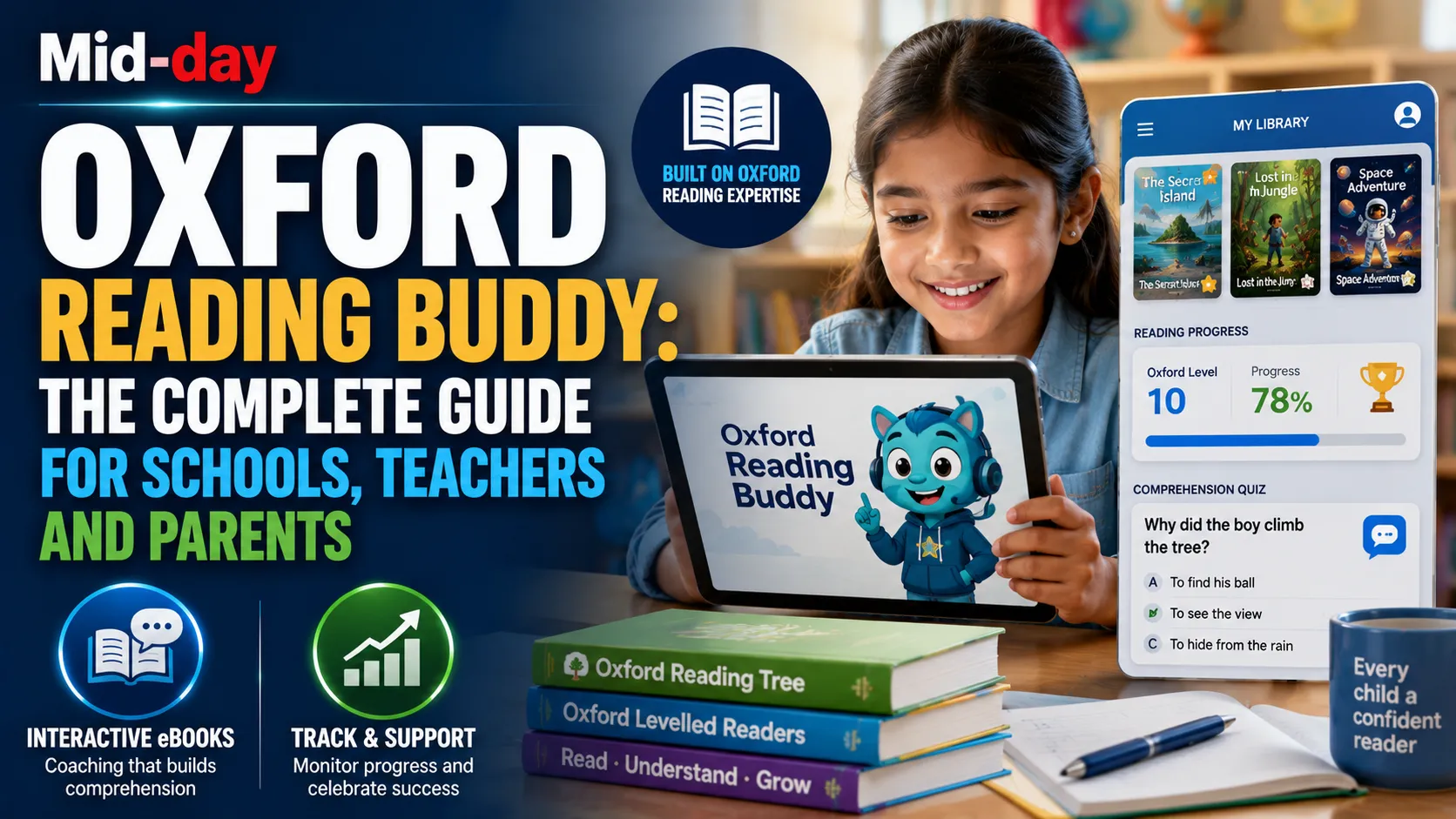
Every primary teacher knows the challenge. Reading practice needs to happen at school and at home. Books need to match the child’s current level. Comprehension has to develop alongside decoding. And monitoring whether a child is genuinely understanding what they read, across a whole class, is a daily administrative burden. Oxford Reading Buddy was designed to address all of this in one place, built on Oxford University Press’s extensive reading materials and backed by formal independent research.
This guide covers what Oxford Reading Buddy is, how it works for teachers, students, and parents, what the evidence says, and how to get the most from it in practice.
Oxford Reading Buddy is a digital reading service developed by Oxford University Press (OUP), the publishing division of the University of Oxford. It is described by OUP as a service that makes reading interactive, motivating, and engaging for children aged 4 to 11, with hundreds of eBooks and comprehension quizzes aligned to Oxford Reading Levels and teacher tools to monitor and support each child’s personal reading and comprehension progress.
The platform is accessible through a web browser on desktop computers and through a dedicated companion app for iOS and Android that allows eBooks to be downloaded for offline reading. Access requires a school subscription. The platform sits at oxfordreadingbuddy.oup.com.
Oxford Reading Buddy is a subscription-based service marketed primarily to UK primary schools, with separate subscription tiers for infant schools, junior schools, and primary schools. OUP India and OUP Pakistan both operate regional versions of the platform serving those markets with content aligned to their respective national curricula.
Oxford Reading Buddy is a product of Oxford University Press (OUP), which is a department of the University of Oxford and one of the world’s oldest and largest academic and educational publishers. OUP is also the publisher of Oxford Reading Tree, the Oxford Levelled Readers series, and a wide range of other primary literacy resources that form the content foundation of Oxford Reading Buddy’s eBook library.
This matters for understanding the platform’s content quality: the eBooks available in Oxford Reading Buddy are published materials from OUP’s established primary reading catalog, not content produced exclusively for the digital platform.
Oxford Reading Buddy combines several distinct types of content and functionality into one platform.
The Coaching eBooks are the signature and most distinctive feature of Oxford Reading Buddy. Each coaching eBook is accompanied by an interactive, personalized reading buddy character who coaches the child through the reading experience. The Reading Buddy does not simply read the text aloud. It models key comprehension strategies, asks questions that promote deeper thinking about the text, and provides feedback.
According to OUP’s own description, the Reading Buddy prompts and Reading Buddy questions within the Coaching eBooks include elements such as “What about this? Have you thought about…?” which encourages children to engage in higher-order thinking as they read rather than simply decoding words. This approach is grounded in explicit comprehension strategy instruction, which is well-supported in the reading research literature.
Beyond the coaching eBooks, Oxford Reading Buddy provides access to a broader eBook library containing hundreds of titles from beloved Oxford reading series. This includes materials from Oxford Reading Tree, which is one of the most widely used reading schemes in UK primary schools, as well as other OUP reading series.
The eBook library operates on the Oxford Levels framework, which provides a consistent, structured progression through reading difficulty. Children are placed at the correct Oxford level and progress through the library at their own pace, with automatic progression when they demonstrate readiness.
Each eBook in the library is accompanied by a comprehension quiz tailored to the specific text. These quizzes check understanding after reading rather than during, complementing the in-text coaching of the coaching eBooks with a post-reading assessment element.
Oxford Reading Buddy uses the Oxford Levels framework, which provides a progressive structure for reading development. This framework maps to other widely used reading level systems, including Book Bands and Oxford Reading Tree stages, which helps teachers who are familiar with those systems understand how the digital levels relate to their existing assessment language.
Automatic progression within the platform places children at their current level based on their performance and moves them on when they demonstrate sufficient readiness. This removes the administrative burden of manually updating book levels for each child, which is one of the most time-consuming aspects of managing a whole-class reading program.
For teachers, Oxford Reading Buddy provides at-a-glance reporting at the school, class, and individual child level. Reports show which books children have read, how they have performed on comprehension quizzes, time spent reading, and progression through Oxford levels.
According to OUP’s marketing materials, this monitoring capability allows teachers to identify where a child needs extra support and to have evidence of progress to share with parents and for internal assessment purposes.
Oxford University Press commissioned an independent impact study to evaluate the coaching eBooks component of Oxford Reading Buddy before the full platform was launched.
Researchers from the School of Education at the University of Southampton conducted a randomized controlled trial involving 322 Year 1 and Year 5 pupils across three schools over one school term (Summer 2018). Classrooms were randomly allocated to either the experimental group, which used prototype coaching eBooks, or the control group, which did not.
Key findings from the study included:
It is important to be clear about the scope of this evidence. The study evaluated prototype coaching eBooks, not the full Oxford Reading Buddy platform as it is currently sold. It involved 322 pupils over one term. It assessed reading attitudes and comprehension engagement rather than standardized reading attainment scores. This is a meaningful evidence base, particularly for a product commissioned by an academic publisher with a commitment to evidence-informed practice, but it is not equivalent to a large-scale, long-term randomized controlled trial measuring reading age gains. Schools that prioritize the Education Endowment Foundation (EEF) standards for evidence when evaluating edtech tools should note this distinction.
OUP’s own pedagogy page for Oxford Reading Buddy references the EEF Digital Technology Guidance Report and the National Literacy Trust’s report on children, young people, and digital reading as evidence frameworks that Oxford Reading Buddy is designed to meet. Checking the EEF’s own Teaching and Learning Toolkit entries on digital technology in education can help schools contextualize this evidence claim accurately.
Teachers log in through a web browser to access the management dashboard. The dashboard shows class-level data, individual child progress, book completions, quiz performance, and reading time. Teachers can assign books, set targets, and communicate with parents through the platform.
One of the most practically significant features for teachers is the reduction in administrative overhead around reading book management. Schools that use physical reading scheme books face the daily challenge of matching books to children’s current levels and updating those assignments as children progress. Oxford Reading Buddy handles level-appropriate assignments automatically, which several school testimonials highlight as a significant time saver.
Multiple verified school testimonials highlight reduced parent frustration about the pace of book changes, because Oxford Reading Buddy makes a child’s reading level and comprehension performance visible to parents in a way that removes some of the miscommunication that arises when parents only see whether a physical book was returned or swapped.
Children access Oxford Reading Buddy through a browser on school computers or tablets or through the offline app on their own device at home. They see their Reading Buddy character, their current eBooks, and their progress.
The interactive nature of the coaching eBooks means that reading is not a passive activity. The Reading Buddy character asks questions at key moments in the text, prompting the child to think before turning the page. This active engagement with the text while reading, rather than only at the end through a quiz, is more consistent with how skilled readers process text than simply reading through and answering questions afterward.
Parents access a separate view within Oxford Reading Buddy that shows their child’s reading progress, current level, books completed, and comprehension performance. This visibility was specifically highlighted in school testimonials as beneficial for families where English is an additional language (EAL), since it gives parents information about their child’s comprehension development in a format that does not require them to have strong literacy in English themselves.
According to OUP’s parent-facing materials, the platform serves as an at-home tutor coaching the child through the reading journey. This positions it as a supplement to parental involvement rather than a replacement for it, which aligns well with the research evidence on family engagement in reading.
Oxford Reading Buddy sits within a competitive market of school digital reading platforms. Understanding how it differs from the main alternatives helps schools make informed decisions.
| Feature | Oxford Reading Buddy | MyOn (Renaissance) | Reading Eggs | Bug Club (Pearson) |
|---|---|---|---|---|
| Coaching during reading | Yes (Coaching eBooks) | No | Limited | Limited |
| Content brand | Oxford Reading Tree and OUP series | Mixed publishers | Original content | Pearson reading schemes |
| Independent evidence base | Yes (Southampton RCT, 2018) | Yes | Limited formal trials | Limited formal trials |
| Offline app | Yes | No | No | No |
| Age range | 4-11 | 4-14 | 2-13 | 3-11 |
| Curriculum alignment | Oxford Reading Levels, England, NC | Accelerated Reader levels | Australian curriculum | Bug Club levels |
The most distinctive feature of Oxford Reading Buddy compared to most alternatives is the Coaching eBook format, which provides interactive comprehension coaching during the reading process. Most digital reading platforms provide post-reading quizzes but do not intervene with comprehension prompts while the child is reading. This during-reading scaffolding is the feature that OUP’s research evidence most directly supports.
A few observations from educational research and literacy teaching are worth understanding when evaluating Oxford Reading Buddy’s approach.
The Coaching eBook model reflects established comprehension strategy instruction research. The during-reading questioning approach used by the Reading Buddy character is consistent with research on reciprocal teaching and think-alouds as comprehension strategies. The “Have you thought about…?” prompts are designed to model the self-monitoring and questioning behavior that proficient readers use automatically but less-skilled readers need to be taught explicitly.
The parent visibility feature may be the most undervalued aspect of the platform. School testimonials from teachers who work with EAL families specifically highlight the value of parents being able to see comprehension data even when they may not feel confident directly supporting reading comprehension at home. This bridges a gap in parental engagement that many schools struggle with.
Automatic level progression removes a pain point but requires monitoring. The automatic progression feature reduces teacher administration but should be verified periodically against teacher assessment, since algorithm-based progression does not capture everything a teacher would observe in a listening or guided reading session. The reporting tools are designed to support, not replace, teacher professional judgment.
The offline app significantly extends accessibility. The Google Play listing confirms that the companion app allows eBooks to be downloaded for offline reading, with audio included. This matters for children in households without reliable internet access, removing a barrier that is often discussed but rarely solved in school edtech platforms.
Treating it as a substitute for guided reading or teacher-led sessions. Oxford Reading Buddy is designed to support independent reading and comprehension practice, not to replace the quality of interaction in a guided reading group. The platform works best as a complement to direct teaching.
Not activating home access or not communicating it clearly to parents. The platform includes parent access that extends reading practice to the home environment. Schools that purchase a subscription but do not enable and communicate the home access feature are leaving a significant part of the product’s value unused.
Setting it up and walking away without checking the progress reports. The monitoring dashboard is most useful when teachers review it regularly and use it to identify children who are not progressing, who are completing books without adequate comprehension, or who have not been reading recently. Passive subscription use produces far less value than active data-informed use.
Assuming automatic level placement is always accurate. The platform places children based on their responses, but early placements should be verified against teacher reading assessments and any existing book-level data. An inaccurate starting level affects the quality of the reading experience until it is corrected.
For schools evaluating Oxford Reading Buddy:
For teachers already using the platform: 4. Review the monitoring dashboard at least fortnightly during term time rather than only at formal assessment points. 5. Activate and communicate home access to parents at the start of the subscription period, with specific guidance on how parents can view their child’s progress. 6. Use the Coaching eBooks with whole classes on an interactive whiteboard as a shared reading activity before assigning them for individual independent practice. This models the comprehension strategy approach before children work through it alone.
For parents: 7. Ask your child’s school whether they use Oxford Reading Buddy and whether parent access is activated. 8. If access is available, log in and check your child’s reading level and recent comprehension quiz results before helping them choose what to read next. 9. Sit with your child when they use the Coaching eBooks initially, so you understand how the Reading Buddy questions work and can talk about them together.
Oxford Reading Buddy is a well-constructed digital reading service built on OUP’s substantial primary reading catalog and supported by a formal impact study that found positive results for reading attitudes and comprehension engagement. Its most distinctive feature, the coaching eBook format with an interactive reading buddy character modeling comprehension strategies during reading, addresses a gap that most competing reading platforms do not fill.
It is not a complete reading curriculum and should not be treated as one. It works best as a structured supplement to teacher-led reading instruction, extending independent practice into school and home contexts with data visibility that supports both teacher assessment and parent engagement.
For UK primary schools that already use Oxford Reading Tree or other OUP reading materials, the content familiarity and level alignment make it a particularly natural fit. For any school evaluating it, the online evaluation option from OUP’s educational consultants provides the most reliable basis for an informed decision.
What is Oxford Reading Buddy? Oxford Reading Buddy is a digital reading service for children aged 4 to 11, developed by Oxford University Press. It provides hundreds of eBooks aligned to Oxford Reading Levels, interactive coaching eBooks with a reading buddy character who models comprehension strategies during reading, post-reading comprehension quizzes, and teacher and parent reporting tools.
Who publishes Oxford Reading Buddy? Oxford Reading Buddy is published by Oxford University Press (OUP), the academic and educational publishing division of the University of Oxford.
What age group is Oxford Reading Buddy for? Oxford Reading Buddy is designed for children aged 4 to 11, covering the primary school age range from Reception through Year 6 in England.
How do I access Oxford Reading Buddy? The platform is accessible through a web browser at oxfordreadingbuddy.oup.com. A companion app is available on iOS and Android for offline reading of downloaded eBooks. Access requires a school subscription.
What is a Coaching eBook in Oxford Reading Buddy? A coaching eBook is an interactive eBook accompanied by a personalized reading buddy character who models key comprehension strategies and asks questions during reading to encourage deeper thinking. This during-reading coaching is the signature differentiating feature of Oxford Reading Buddy compared to standard digital reading platforms.
Is there evidence that Oxford Reading Buddy works? Oxford University Press commissioned an independent impact study conducted by researchers from the University of Southampton School of Education. The study, a randomized controlled trial involving 322 Year 1 and Year 5 pupils, found significantly more positive attitudes to reading in pupils using prototype coaching eBooks, particularly in Year 5. The study was on prototype materials rather than the finished platform and measured attitudes and engagement rather than standardized reading attainment scores.
Can children use Oxford Reading Buddy at home? Yes. A school subscription to Oxford Reading Buddy includes home access for pupils, allowing children to read eBooks at home through a browser or the offline companion app. Parents have a separate login view to monitor their child’s progress.
What is the Oxford Reading Levels framework? Oxford Reading Levels is a structured progression framework used to organize reading materials by difficulty. Within Oxford Reading Buddy, it provides the structure for automatic level placement and progression and maps to other reading level systems, including Book Bands.
How does Oxford Reading Buddy compare to Bug Club or Reading Eggs? Oxford Reading Buddy’s key differentiator is the Coaching eBook feature, which provides comprehension strategy coaching during reading rather than only post-reading quizzes. Bug Club and Reading Eggs are primarily post-reading quiz models. Oxford Reading Buddy’s content is drawn from OUP’s established series, including Oxford Reading Tree, while Bug Club uses Pearson materials and Reading Eggs uses its own content.
Is there an offline version of Oxford Reading Buddy? Yes. The companion app for iOS and Android allows eBooks to be downloaded for offline reading with audio included. This means children can access their books without a live internet connection.
Also, Check out MDRRMO Philippines: What It Is and How It Works





[…] Check more: Oxford Reading Buddy: Complete Guide for Schools and Parents […]
[…] Read More: Oxford Reading Buddy: Complete Guide for Schools and Parents […]
[…] For reading development specifically, dedicated reading practice and phonics programs such as Oxford Reading Buddy, Little Wandle, or school-assigned reading books remain more appropriate than the English games on […]