Physical Address
304 North Cardinal St.
Dorchester Center, MA 02124
Physical Address
304 North Cardinal St.
Dorchester Center, MA 02124

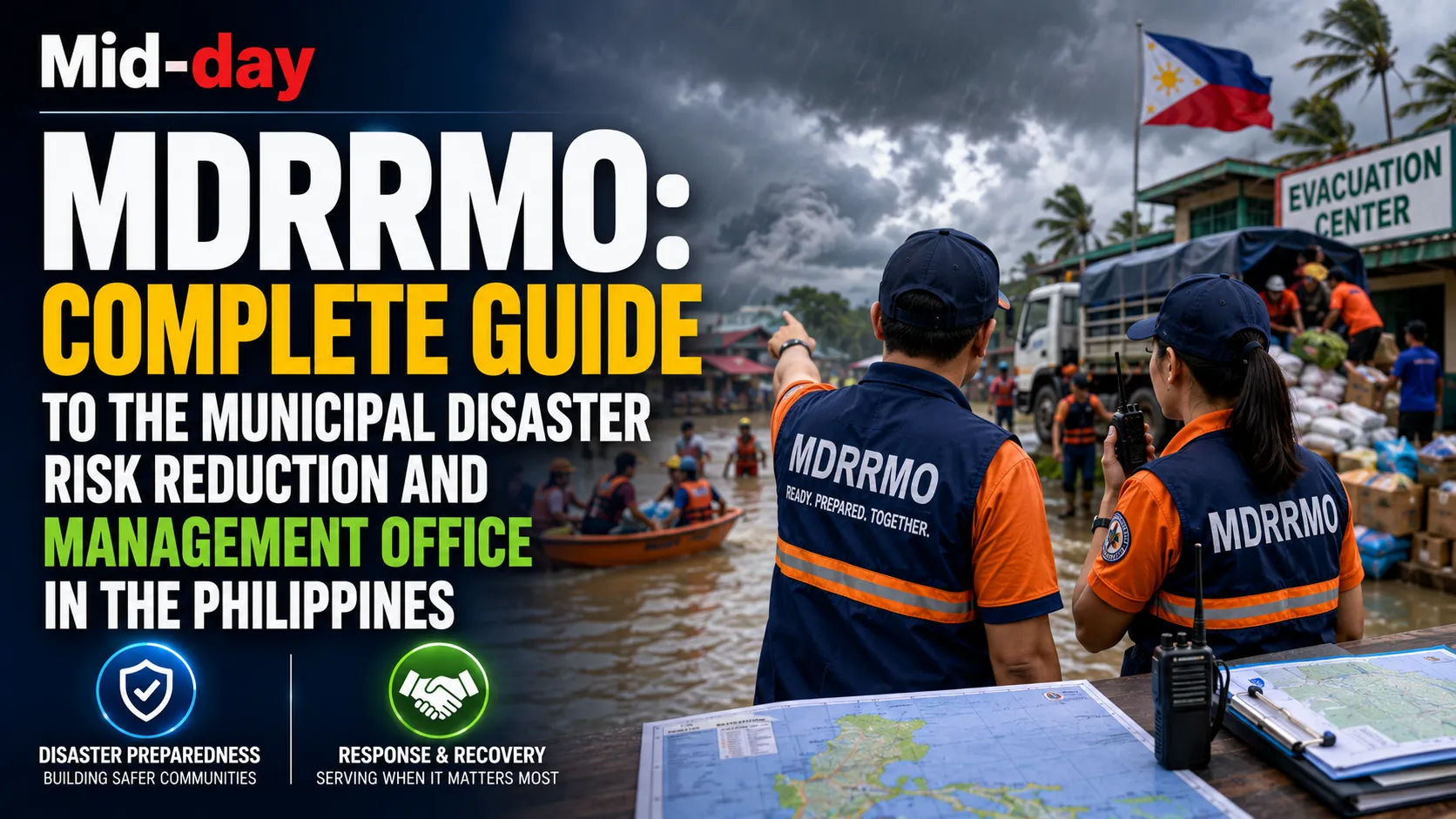
When a typhoon bears down on the Philippines, when flooding overtops riverbanks in a provincial municipality, or when an earthquake triggers landslides in a mountain barangay, the first structured government response at the local level typically comes from the Municipal Disaster Risk Reduction and Management Office. Known by its acronym MDRRMO, this office operates in every municipality across the Philippine archipelago and serves as the frontline government unit for disaster prevention, preparedness, response, and recovery.
This guide explains what MDRRMO is, the law that created it, what it does across its four mandated functions, how it is organized, and what the public can expect from it before, during, and after a disaster.
MDRRMO stands for Municipal Disaster Risk Reduction and Management Office. It is the disaster risk management office that operates at the municipal level of local government in the Philippines. Each municipality in the country is required to establish and maintain its own MDRRMO in compliance with national law.
The equivalent offices at other levels of government are the Barangay Disaster Risk Reduction and Management Committee (BDRRMC) at the village level, the City Disaster Risk Reduction and Management Office (CDRRMO) at the city level, the Provincial Disaster Risk Reduction and Management Office (PDRRMO) at the provincial level, and the Office of Civil Defense (OCD) at the national level, under the National Disaster Risk Reduction and Management Council (NDRRMC).
MDRRMO was created through Republic Act 10121, formally titled the Philippine Disaster Risk Reduction and Management Act of 2010. This law, signed on May 27, 2010, by President Benigno Aquino III, fundamentally restructured how the Philippines approaches disasters by shifting from a reactive emergency response framework to a proactive disaster risk reduction approach.
Before RA 10121, local disaster management was handled by Local Disaster Coordinating Councils under Presidential Decree 1566 of 1978. The old system was primarily focused on post-disaster relief and response. The new law mandated a comprehensive approach that begins before disasters strike, addressing the underlying vulnerabilities and hazards that make communities susceptible to harm.
Key provisions of RA 10121 relevant to the MDRRMO include:
The MDRRMO’s mandate is organized around four thematic areas defined in RA 10121 and its implementing rules. These four areas govern all MDRRMO programs, projects, and activities.
This thematic area addresses the reduction of hazard risk before a disaster occurs. Prevention work aims to reduce or eliminate the likelihood of a disaster happening. Mitigation work aims to reduce the impact of a disaster that cannot be fully prevented.
Practical activities under this area include:
Preparedness activities build the capacity of communities and government institutions to respond effectively when a disaster strikes. This is perhaps the most visible day-to-day work of many MDRRMO offices.
Preparedness activities include:
Disaster response covers the actions taken during and immediately after a disaster to save lives, protect property, and stabilize the situation. This is the most time-critical phase of DRRM work.
Response activities include:
This thematic area covers the medium- and long-term work of restoring communities after a disaster. Recovery goes beyond the immediate emergency period to help communities return to normal or improved conditions.
Recovery activities include:
The specific organizational structure of an MDRRMO varies depending on the size, resources, and classification of the municipality. However, RA 10121 and its implementing rules set minimum requirements that all municipal DRRM offices must meet.
The office is headed by the Local Disaster Risk Reduction and Management Officer (LDRRMO), who must have a background in disaster risk management, community development, or a related field. In practice, LDRRMO positions vary widely in qualification and compensation across the country’s more than 1,600 municipalities.
Staff positions at the MDRRMO typically include disaster risk reduction and management specialists organized by the four thematic areas; rescue and response personnel; administrative support; and, in some municipalities, community extension workers embedded in high-risk barangays.
The MDRRMO works under the overall supervision of the local chief executive, typically the municipal mayor, and coordinates with the Municipal Disaster Risk Reduction and Management Council (MDRRMC), which includes representatives from local government departments, the private sector, civil society organizations, and relevant national government agencies operating at the local level.
One of the most important provisions of RA 10121 is the mandatory allocation of at least five percent of the LGU’s estimated revenue from regular sources to the Local Disaster Risk Reduction and Management Fund. This fund is divided into two components:
Unobligated balances of the preparedness allocation at the end of the fiscal year can be carried over to the next year for use as a disaster response fund.
The adequacy of LDRRMF allocation is a recurring issue in Philippine local government. Municipalities with lower revenue bases may allocate only small absolute amounts even when meeting the five percent requirement, and the actual expenditure and accountability of LDRRMF funds have been the subject of Commission on Audit findings in numerous LGUs.
The MDRRMO does not operate in isolation. It functions as part of a nested structure of disaster risk management institutions at the barangay, municipal, provincial, regional, and national levels. Understanding these coordination relationships clarifies how resources and information flow during a disaster.
Upward coordination: The MDRRMO reports to and receives guidance from the Provincial Disaster Risk Reduction and Management Office (PDRRMO) and the Office of Civil Defense (OCD) regional office. During major disasters, requests for assistance beyond municipal capacity are routed upward through this chain.
Downward coordination: The MDRRMO coordinates with and provides guidance and resources to the Barangay Disaster Risk Reduction and Management Committees (BDRRMCs) in each barangay of the municipality. Barangay-level early warning, evacuation, and response capabilities are built through the MDRRMO’s capacity development programs.
Horizontal coordination: The MDRRMO coordinates with other municipal departments, including the health office, engineering office, social welfare office, agriculture office, and local police and fire stations. During emergencies, these departments provide specialized functions under the overall coordination of the MDRRMO and the emergency operations center.
National agency coordination: The MDRRMO maintains working relationships with PAGASA for weather forecasting and warnings, PHIVOLCS for volcanic and earthquake monitoring, MGB for geological hazard assessments, DSWD for social protection and relief, and the Philippine National Red Cross (PNRC) for supplementary disaster response capacity.
Municipal residents can access a range of services through their local MDRRMO, both in normal times and during emergencies.
Non-emergency services:
Emergency services:
Several observations from disaster risk management practitioners and researchers provide useful context for understanding how MDRRMOs function in practice.
Capacity varies significantly across municipalities. The Philippines has more than 1,600 municipalities with widely varying revenue bases, staffing levels, and political priorities. A well-resourced municipality with a professional, trained LDRRMO and adequate LDRRMF will have substantially greater disaster response capability than a smaller, lower-income municipality where the MDRRMO may be understaffed or under-resourced.
The Community-Based Disaster Risk Management (CBDRM) approach is central to effectiveness. Effective DRRM at the municipal level depends substantially on building capacity within barangays and communities rather than concentrating all capability in the MDRRMO office itself. Municipalities that have invested in strong BDRRMC capacity and community volunteer training tend to show faster and more effective local response to small and medium-scale events.
RA 10121 created the right framework, but implementation gaps persist. Post-disaster assessments and audit reports have consistently identified gaps in areas including LDRRMF utilization accountability, LDRRMP quality and currency, evacuation center preparedness, and early warning system maintenance. The framework created by RA 10121 is sound, but translating it into operational capacity across 1,600-plus municipalities with uneven resources remains a genuine and ongoing challenge.
Climate change is increasing the demands on MDRRMO. Intensifying typhoons, more extreme rainfall events, and changing seasonal patterns are increasing the frequency and severity of disasters that MDRRMOs must manage. This is placing growing pressure on LDRRMF resources and on the administrative and technical capacity of local DRRM offices.
“MDRRMO is only active during typhoons.” The bulk of effective MDRRMO work happens between disasters: updating hazard maps, training community volunteers, maintaining equipment, conducting drills, and coordinating early warning systems. An MDRRMO that only activates during typhoons is not fulfilling its mandate under RA 10121.
“The MDRRMO manages all disaster funding in the municipality.” The MDRRMO manages the Local DRRM Fund, but disaster response in the Philippines also draws on the National DRRM Fund (managed at the national level through the NDRRMC), DSWD’s Quick Response Fund for social protection needs, and congressional calamity funds. The MDRRMO coordinates these different funding streams but does not control all of them.
“All MDRRMOs have the same capability.” Given the variation in municipal revenue, population, hazard exposure, and political support for DRRM, capability varies enormously. This is a known issue in the DRRM system and is addressed through capacity development programs by the OCD and national agencies.
“MDRRMO and MDRRMC are the same thing.” The MDRRMO is the office with professional staff responsible for day-to-day operations and implementation. The MDRRMC is the council chaired by the mayor that includes multiple agencies and sectors and provides policy direction and oversight. The LDRRMO typically serves as the MDRRMC secretariat.
Before a disaster:
During a typhoon or flood warning: 6. Follow official evacuation orders from your barangay officials and the MDRRMO without delay. 7. Contact the MDRRMO emergency hotline if you need rescue assistance and cannot evacuate on your own. 8. Do not wait for floodwaters to rise before evacuating if you are in a low-lying or flood-prone area.
After a disaster: 9. Contact the MDRRMO or barangay for information on relief distribution schedules. 10. If your home was damaged or destroyed, register with the barangay and MDRRMO for damage assessment documentation, which is required for accessing government assistance programs.
The Municipal Disaster Risk Reduction and Management Office is a legally mandated institution at the heart of the Philippines’ local government disaster management system. Created under Republic Act 10121, it is responsible for prevention and mitigation, preparedness, response, and rehabilitation and recovery activities across the territory of its municipality.
Its effectiveness depends on adequate funding through the Local DRRM Fund, professional leadership, coordination with barangay-level institutions, and strong relationships with provincial, regional, and national DRRM structures. As the Philippines faces increasingly intense climate-related hazards, the role of the MDRRMO as the frontline local government disaster management institution continues to grow in importance.
What does MDRRMO stand for? MDRRMO stands for Municipal Disaster Risk Reduction and Management Office. It is the disaster risk management office at the municipal level of local government in the Philippines, established under Republic Act 10121 of 2010.
What law created the MDRRMO? Republic Act 10121, the Philippine Disaster Risk Reduction and Management Act of 2010, signed on May 27, 2010, created the mandate for every local government unit in the Philippines to establish a Disaster Risk Reduction and Management Office.
What are the four functions of MDRRMO? The four mandated thematic areas of the MDRRMO are disaster prevention and mitigation, preparedness, disaster response, and rehabilitation and recovery.
What is the LDRRMF? The Local Disaster Risk Reduction and Management Fund (LDRRMF) is the mandatory budget allocation under RA 10121 requiring local government units to set aside at least five percent of their estimated revenue from regular sources for disaster risk reduction and management. Seventy percent is reserved as a quick response fund for emergencies and thirty percent for preparedness programs.
What is the difference between MDRRMO and MDRRMC? The MDRRMO is the professional office with dedicated staff that implements DRRM programs day to day. The MDRRMC (Municipal Disaster Risk Reduction and Management Council) is the policy-making body chaired by the mayor, which includes representatives from multiple government departments, agencies, and the private sector. The MDRRMO serves as the secretariat for the MDRRMC.
Who heads the MDRRMO? The MDRRMO is headed by the Local Disaster Risk Reduction and Management Officer (LDRRMO), who must meet qualification standards set by the Civil Service Commission and the OCD.
How is MDRRMO different from the old disaster coordinating council system? Before RA 10121, local disaster management was handled by Local Disaster Coordinating Councils under Presidential Decree 1566 of 1978. The old system focused primarily on post-disaster relief. RA 10121 replaced this with a proactive, risk reduction-focused approach that addresses vulnerabilities before disasters happen, not just after.
What national agencies does MDRRMO coordinate with? MDRRMO coordinates with PAGASA (weather), PHIVOLCS (volcanoes and earthquakes), MGB (geological hazards), DSWD (social welfare and relief), the Office of Civil Defense, the Philippine National Red Cross, and various other national agencies depending on the specific disaster type and needs.
Also, Check out Cricfy TV: What It Is, Legal Risks, and Safe Alternatives





[…] Also, Check out MDRRMO Philippines: What It Is and How It Works […]