Physical Address
304 North Cardinal St.
Dorchester Center, MA 02124
Physical Address
304 North Cardinal St.
Dorchester Center, MA 02124

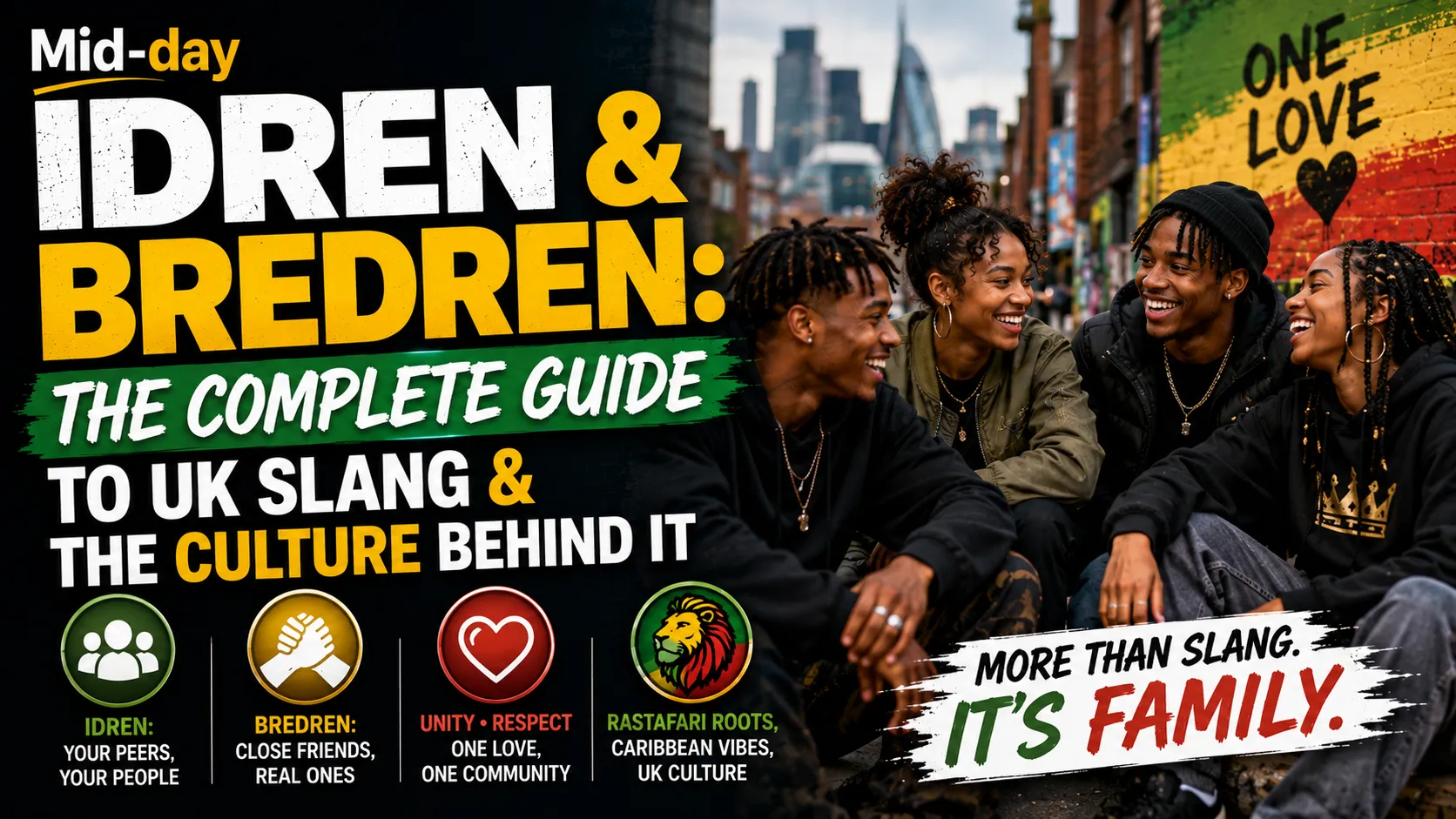
If you have heard the word “idren” in a song, on social media, or in a conversation and wondered what it means, you are not alone. The term appears frequently in UK street slang, music lyrics, and everyday speech, yet its origins and precise meaning often remain unclear to those outside the culture.
This guide explains everything you need to know about “idren” and its close relative “bredren”. These are not merely informal words; they carry cultural significance rooted in Rastafarian tradition and Caribbean influence on British English. Understanding them means understanding a rich linguistic heritage that has shaped modern UK slang.
Idren is a plural noun that means one’s peers, or spiritual brothers and sisters. It originated from Rastafari English, a dialect primarily spoken by Jamaican Rastafarians.
The term derives from a blend of “I” and “bredren”, another Rastafarian term which means a close friend, a family member, or a comrade. The “I” prefix is significant in Rastafarian language, reflecting positive beliefs about unity, peace, and one love.
In practical terms, when someone refers to their idren, they are talking about their close friends, their community, or their spiritual family. It is a term of endearment and respect.
Bredren (also spelled bredrin) is a slang term with similar meaning. The Oxford English Dictionary defines it as a close (male) friend or associate. It is used with singular agreement and is now frequently heard in British, chiefly Afro-Caribbean usage.
The term is a Rastafarian pronunciation of “brethren”. It emerged in the 1980s as slang, originally and chiefly Jamaican, before spreading to the UK.
The Collins English Dictionary defines bredren as a friend or comrade, or a group of friends or comrades. It is a term that denotes close social bonds and community.
To understand idren and bredren, you need to understand Rastafarianism. The Rastafarian movement began in the 1930s in Jamaica and is based on positive beliefs like unity, peace, and one love.
Rastafarian English is different from Jamaican Patois because it is a play on English words, rather than being an entirely separate dialect. The language reflects the positive beliefs of the movement.
The formation of I-words is typical of Rastafarian dialect. These I-words are often applied to terms with spiritual and social connotations.
Examples include:
The “I” prefix replaces the initial sound in words to emphasise the spiritual connection between the speaker and the concept being described.
Both idren and bredren entered British English through Caribbean speech. They have been heard in the UK since approximately 2000, especially among younger speakers.
The terms are part of a broader wave of Caribbean influence on UK slang. Words like “blud” (derived from “blood brothers” and related to “bredren”) have also become common.
The word idren gained wider recognition through popular culture. It appears in the song “Bad Boys” by Inner Circle, which served as the theme song for the television show “COPS”. The lyrics include the line: “Not even you ‘idren naw give you no break”.
This exposure introduced the term to audiences far beyond the Caribbean and Rastafarian communities.
While the terms are closely related, there are some distinctions:
| Aspect | Idren | Bredren |
|---|---|---|
| Meaning | One’s peers, spiritual brothers and sisters | A close friend or associate |
| Origin | Blend of “I” and “bredren” | Rastafarian pronunciation of “brethren” |
| Gender | Can refer to male or female co-Rastas | Often used for male friends |
| Usage | More spiritual and inclusive | More casual and friendship-focused |
| Popularity in UK | Heard since around 2000 | Heard since around 2000 |
Both terms are used as forms of address and to refer to close associates. They reflect the same cultural roots but with slightly different nuances.
These terms are informal and should be used in appropriate contexts. They are common in:
They are not typically used in formal writing or professional settings.
Idren is pronounced “eye-druhn”. Bredren is pronounced “bred-rin” or “bred-ren”.
Here are some examples of how these terms are used:
Misconception 1: Idren and bredren mean the same thing as “brother”.
While they are similar, they carry specific Rastafarian and Caribbean cultural connotations. They are not direct synonyms for “brother” in the generic sense.
Misconception 2: These terms are only used by Rastafarians.
While they originated in Rastafarian culture, they have been adopted more widely in UK slang, particularly among younger speakers and in Afro-Caribbean communities.
Misconception 3: Bredren is just a misspelling of “brethren”.
It is a deliberate Rastafarian pronunciation that reflects the dialect’s play on English words.
Misconception 4: These terms are offensive.
They are not offensive. They are terms of endearment and respect used among friends and community members.
Misconception 5: Only men use these terms.
While bredren is often used for male friends, idren can refer to both male and female co-Rastas.
These terms reflect the importance of community in Rastafarian and Caribbean culture. They emphasise connection, mutual support, and spiritual kinship.
Using idren or bredren is a way of signalling cultural identity and belonging. It connects the speaker to a linguistic tradition that values unity and respect.
The “I” prefix in idren is more than just a letter. It represents the Rastafarian belief in the unity of all people and the divine presence within each individual. This is why I-words are so significant in Rastafarian language.
These terms appear frequently in reggae, dancehall, and UK grime music. Artists use them to address their fans, their friends, and their community.
The song “Bad Boys” by Inner Circle is perhaps the most famous example, bringing the word idren to a global audience.
The use of idren in the “COPS” theme song helped cement the term in popular consciousness. Caribbean and UK urban culture have also featured these terms in various productions.
On platforms like Instagram, TikTok, and Twitter, idren and bredren are used in posts, comments, and hashtags. They have become part of the digital vocabulary of younger generations.
Understanding idren and bredren is easier when you know related terms:
These terms all share the same cultural and linguistic roots.
If you are new to these terms, start by listening to how they are used in context. Music, social media, and conversations are great places to learn.
If you want to use them correctly, remember that they are informal terms of friendship and respect. Use them with people you know well and in appropriate settings.
If you are interested in the culture, explore Rastafarian history and language. Understanding the origins of these terms enriches your appreciation of their meaning.
If you are a writer or content creator, use these terms authentically when writing about UK urban culture, music, or Caribbean influence on British English. Provide context for readers who may not be familiar with them.
If you are teaching or explaining, share the cultural background. These terms are more than slang; they carry meaning and history.
Idren and bredren are more than just slang words. They are linguistic markers of community, respect, and cultural identity. Rooted in Rastafarian tradition and brought to the UK through Caribbean influence, they have become part of the rich tapestry of British English.
Understanding these terms means understanding the values they represent: unity, peace, and one love. Whether you hear them in a song, see them on social media, or use them with your friends, they carry a meaning that goes beyond simple friendship.
The next time someone calls you their idren or bredren, you will know that they are offering you more than just a friendly greeting. They are welcoming you into their community.
Idren means one’s peers, or spiritual brothers and sisters. It originated from Rastafari English and is used to refer to close friends or community members. The term is a blend of “I” and “bredren.”
Bredren is a slang term meaning a close friend or associate. It is a Rastafarian pronunciation of “brethren” and is now frequently used in British, chiefly Afro-Caribbean, usage.
Both terms come from Rastafarian English, a dialect spoken by Jamaican Rastafarians. The Rastafarian movement began in the 1930s in Jamaica and is based on positive beliefs like unity, peace, and one love.
They are closely related but not identical. Idren is more spiritual and inclusive, referring to peers and spiritual brothers and sisters. Bredren is more casual and often refers specifically to male friends.
Idren is pronounced “eye-druhn.”
Yes. Idren and bredren have been heard in the UK since around 2000, especially among younger speakers and in Afro-Caribbean communities.
Yes. Idren can refer to male or female co-Rastas. It is not gender-specific in the way that bredren sometimes is.
Idren is a product of Rastafarian English, which is a play on English words. The “I” prefix is typical of Rastafarian dialect and reflects the movement’s positive beliefs about unity and the divine within each person.
The most famous example is “Bad Boys” by Inner Circle, which was the theme song for the television show “COPS”. The lyrics include the line: “Not even you ‘idren naw give you no break”.
No. Bredren is not offensive. It is a term of friendship and respect, used among close associates.
Read More: Преведувач: Best Macedonian Translation Tools (2026)





[…] Read More: Idren and Bredren: UK Slang Meanings and Origins […]