Physical Address
304 North Cardinal St.
Dorchester Center, MA 02124
Physical Address
304 North Cardinal St.
Dorchester Center, MA 02124

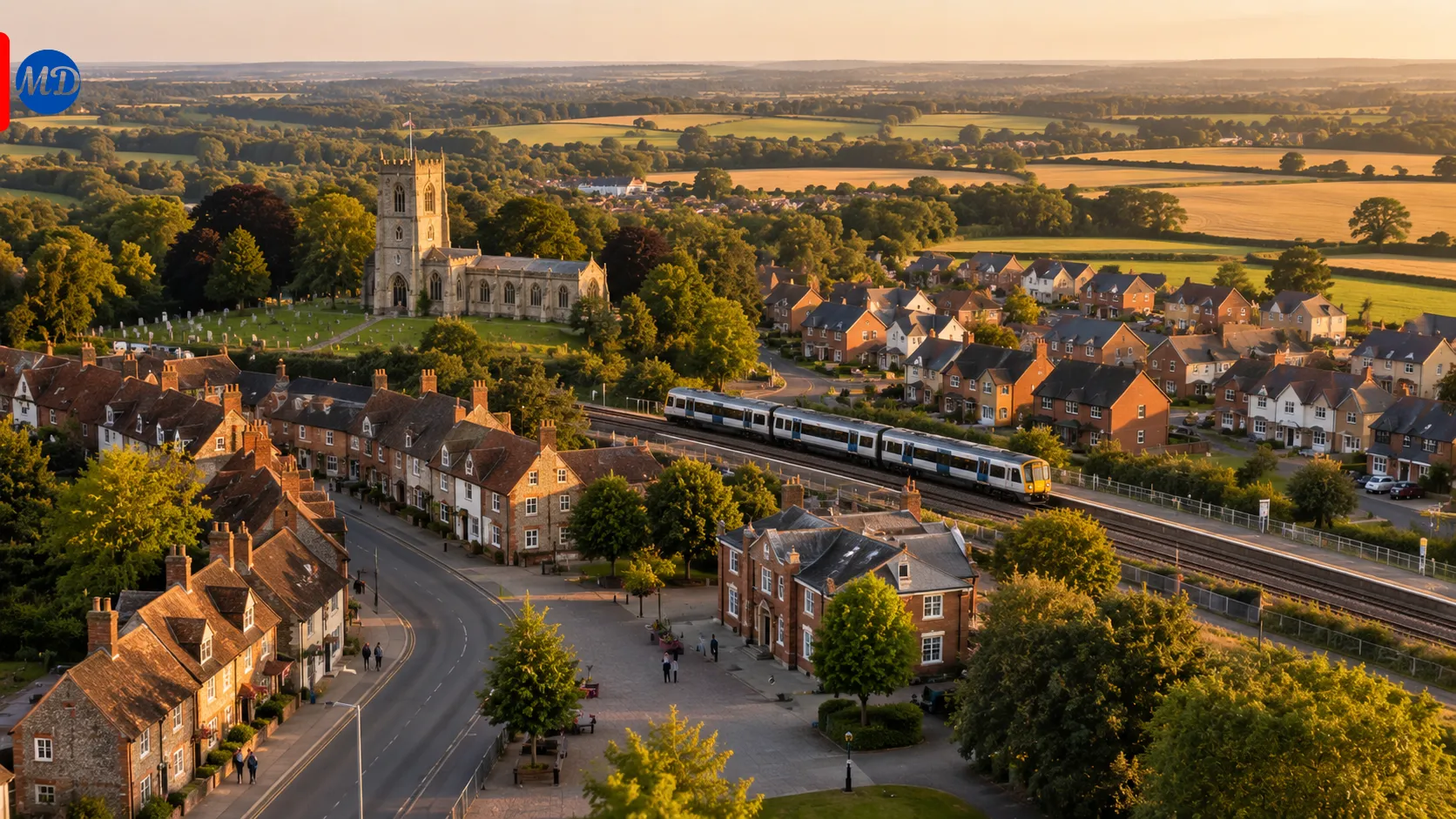
Elmswell is one of those places that surprises people. Officially still a village, it carries the population, infrastructure and pace of something considerably larger. Sitting midway between Bury St Edmunds and Stowmarket in the heart of Mid Suffolk, it has a railway station, a library, sports clubs, a post office, a pharmacy, a butcher, a community centre and several pubs. That combination is unusual for a village of any size, and it explains why Elmswell has grown faster than almost anywhere else in Suffolk in recent years.
This guide covers the village comprehensively: its history, how to get there, what to expect day to day, what the property market looks like, and what there is to do nearby. Whether you are considering moving here, planning a visit, or simply researching the area, this is the information you need.
Elmswell is a village and civil parish in the county of Suffolk, England. It sits in the Mid Suffolk district, administered by Suffolk County Council. The village lies just north of the A14, roughly halfway between Bury St Edmunds to the west and Stowmarket to the east.
Its grid reference is TL 9897 6386, and its postcode district is IP30. The nearest major urban centre is Bury St Edmunds, approximately 8 miles to the west. Cambridge is reachable within about an hour by road or rail. Ipswich lies to the south-east.
The surrounding landscape is typical of mid-Suffolk: open arable farmland, hedgerow boundaries, and quiet lanes connecting dispersed rural settlements. The village itself sits on slightly raised ground, with the parish church of St John the Divine visible from some distance on its low hill.
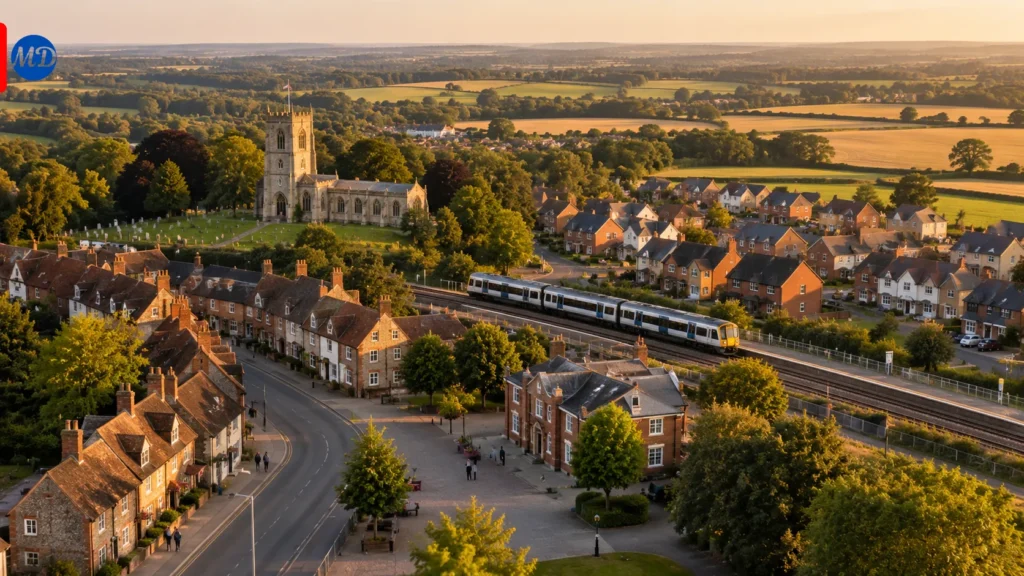
The history of Elmswell reaches back well before the Norman Conquest. Archaeological excavations near St John’s Church have uncovered the remains of a Romano-British pottery kiln dating from between the 2nd and 4th centuries AD, placing human settlement in the area during the Roman occupation of Britain.
The Anglo-Saxon roots of the village are reflected in its name. According to the Oxford Dictionary of English Place-Names, “Elmswell” derives from the Old English “Elmswella,” a combination of “elm” and “wella,” meaning “spring or stream where elm trees grow.” This original form appears in the Domesday Book of 1086, where the village is recorded as “Elmeswella.”
At the time of the Domesday survey in 1086, Elmswell was held by the monastery of St Edmunds in Bury, under Abbot Baldwin. The connection to the Bury St Edmunds monastery was long-standing. Records show that in 956, the young King Eadwig gave the estate of Elmswell to the monastery at Bury St Edmunds as a gift.
Elmswell Hall, a late 16th-century monastic grange, is believed to have much earlier origins. Henry VI and his courtiers paid an extended visit to Elmswell in 1433 for fishing, hunting and hawking.
One of the most significant historical figures connected to Elmswell is Sir Robert Gardiner, who purchased Elmswell Manor and Hall from the Darcy family in 1590. He served as Chief Justice of Ireland for 18 years before he died in 1619 at the age of 80. Gardiner erected an almshouse in the village for widows of both Elmswell and the neighbouring village of Woolpit. The almshouses, built in 1614, still stand today and are visible from the fields to the west of the village.
A marble monument to Sir Robert Gardiner survives inside the church of St John the Divine, and an effigy in his honour is recorded in historical descriptions of the building.
John Speed’s map of 1610 records the village as “Elmeswell,” showing a spelling transitional between the Domesday record and the modern form.
The arrival of the railway transformed Elmswell’s physical and economic character. Elmswell railway station opened on 24 December 1846, built by the Ipswich and Bury Railway Company, which had been formed to construct a line from Ipswich to Bury St Edmunds. The company shared shareholders and directors with the Eastern Union Railway and the same head office in Brook Street, Ipswich.
The railway’s arrival had a lasting effect on the village’s layout. A large village green, known as Butten Haugh Green, once formed the historic centre of Elmswell. The construction of the railway line and, later, the establishment of a bacon factory in 1911 fundamentally altered the village’s geography, and houses now stand on what was once the green.
The village Memorial Hall was built by villagers in 1946 to commemorate those from Elmswell who died fighting during the two World Wars. The hall remains a community facility today. A new school was built in 1986, with a swimming pool funded by the school’s Parent-Teachers Association. A new village sign was erected in 1995, depicting the history of the village.
To mark the centenary of the parish council on 4 December 1994, a time capsule was buried one metre north of the village sign, containing a record of village life on that day.
The 2021 census recorded a population of 4,451 in Elmswell. This figure reflects the significant growth the village has experienced over recent decades through sustained residential development.
The East Anglian Daily Times described Elmswell in 2026 as one of Suffolk’s “fastest-changing” villages, noting that its pace of housebuilding and population growth is more akin to a commuter town than a traditional rural parish. New housing estates sit alongside the village’s older core, where older buildings, the parish church, and the 1614 almshouses still anchor the historic identity of the place.
The Fox pub remains one of the focal points of village life, a space where long-established residents and newer arrivals mix. The parish church of St John the Divine has been described as one of Suffolk’s grander sights, with its churchyard containing 17th- and 18th-century headstones and a recently refurbished interior that includes a glass-fronted gallery and meeting space.
Elmswell is officially classified as a village, but its amenity profile is significantly more developed than that classification suggests. The combination of a working railway station, local shops, a library, a pharmacy, a butcher, a post office, a community centre, and sports facilities is unusual for a settlement of this type and scale anywhere in rural England.
Elmswell railway station is one of the village’s most practical assets. Located on Station Road with the postcode IP30 9HA, the station sits on the Ipswich to Ely line and is operated and managed by Greater Anglia. The station code is ESW.
Trains from Elmswell run approximately once an hour in each direction. Westbound services run towards Bury St Edmunds and Cambridge. Eastbound services run towards Stowmarket and Ipswich. The journey to Bury St Edmunds takes approximately 25 minutes. The journey to Stowmarket takes around 15 minutes. Ipswich is reachable in approximately one hour. London Liverpool Street, via Stowmarket and Ipswich, is reachable in roughly two and a half hours.
Station facilities include accessible toilets, a Changing Places toilet, baby changing facilities, ticket machines, seating, CCTV, help points, passenger assistance, and cycle storage on platform 2. There is no ticket office and no public Wi-Fi.
Passenger numbers at Elmswell station have grown substantially in recent years. The Office of Rail and Road recorded 13,570 journeys in 2020/21, rising to 121,748 in 2024/25, reflecting both the village’s population growth and the post-pandemic recovery of rail travel.
Elmswell sits just to the north of the A14, one of the main trunk roads linking the Midlands with the East of England coast. This gives the village direct road access towards Cambridge and the A11 corridor to the north-west, and towards Ipswich, the A12 and the Suffolk coast to the south-east. The A14 junction makes Elmswell practical for car-based commuters working in either direction.
Local lanes connect the village to neighbouring settlements, including Woolpit, Wetherden, and Haughley. Road conditions are generally good, and the village has safe pedestrian routes and quiet residential streets.
Several bus services connect Elmswell to the surrounding areas. Routes DB1 and TB02 serve the village, alongside additional services. The nearest bus stop to the village centre is Old Schools Court, a short walk from the main amenities.
Elmswell is unusually well-served for a village of its size. Day-to-day needs can be met without leaving the village in most cases.
Shopping and services:
Community and recreation:
Food and drink:
Healthcare:
Education:
Elmswell’s property market has been shaped by sustained new development alongside an existing stock of more traditional housing. The village offers a range of property types, from older brick and flint cottages with traditional Suffolk character to contemporary family homes on newer estates.
The village’s position between Bury St Edmunds and Stowmarket, with its own railway station and A14 access, makes it attractive to commuters working in those towns, in Cambridge, or even in London. For families, the presence of a primary school, the library, and community facilities within the village itself reduces reliance on driving for day-to-day life.
Shared ownership schemes have been available in Elmswell, with developments such as Brook Gardens offering 2, 3 and 4 bedroom homes through the part-buy, part-rent model. These have extended ownership options to buyers who might otherwise be priced out of the area. The homes at this development are located approximately half a mile from Elmswell Train Station.
For those looking at private sale or rental, the market reflects the general Suffolk picture: prices are significantly lower than in London or the South East, while remaining higher than in more remote rural locations. The combination of rail access and village amenity tends to support values in Elmswell above those of comparable villages without transport links.
Elmswell is not a conventional tourist destination with its own list of attractions, but its central position in mid-Suffolk makes it a practical base for exploring a range of sites nearby.
The historic market town of Bury St Edmunds is the closest major centre. It is home to the ruins of the medieval Bury St Edmunds Abbey, the Cathedral Church of St James, the Apex live music venue, the Arc Shopping Centre, and a twice-weekly market. The town has a strong reputation for independent shops, restaurants and cafes.
The village of Woolpit is one of the most attractive in mid-Suffolk and is known for the medieval legend of the Green Children of Woolpit, one of the most curious folk stories in English history. The parish church of St Mary in Woolpit, with its 15th-century nave and Victorian spire rebuilt in 1870 by architect Richard Phipson, is considered a significant building.
The former RAF Great Ashfield station lies approximately 1.5 miles north-east of Elmswell. The airfield was a US Army Air Forces base during the Second World War and is associated with the 385th Bombardment Group. The Rougham Control Tower Aviation Museum, a short drive from Elmswell, explores this wartime history.
The Suffolk countryside around Elmswell offers quiet footpaths and field paths for walking. Komoot lists over 100 hiking routes in the wider Elmswell area. A walk from the railway station, past the newer housing estates to the church and out along field paths to the west, passes the historic almshouses and gives a representative view of how the village has changed while retaining its older fabric.
Located in Stowmarket, the Food Museum is approximately 6 miles from Elmswell and explores the history of food and farming in the region, set within an attractive rural site.
A few things set Elmswell apart from other villages of similar size in rural Suffolk.
The railway is a genuine differentiator. Many Suffolk villages of this scale lack rail access. The ability to commute to Ipswich, Cambridge, Bury St Edmunds or London by train changes the quality of life calculation significantly, especially for households with more than one working adult. Passenger numbers at Elmswell station have nearly doubled in the past three years, reflecting a growing commuter base.
The pace of growth creates tension as well as opportunity. The East Anglian Daily Times described Elmswell as a “test case for how rural Suffolk absorbs relentless housing growth while trying to hold on to a sense of itself.” New arrivals bring economic activity and demand for services, but also shift the social character of a place that was, within living memory, a much smaller rural community. This is worth understanding before moving to the village.
The historical depth is often underestimated. Most coverage of Elmswell focuses on its modern growth, but the village has a documented history stretching from Romano-British pottery production through Anglo-Saxon land grants, medieval royal visits, a significant 16th-century legal figure, and Victorian industrial change. The layers of history are visible in the landscape if you look for them.
The amenity set is genuinely unusual. Finding a village with a pharmacy, butcher, library, post office, railway station, community centre and sports clubs in one place is rare in rural England. For many residents, this means village life without the dependency on car travel that affects most comparable locations.
“It is too small to have useful facilities.” In fact, Elmswell has a notably strong amenity base for a village. Daily shopping, postal services, pharmacy, and community facilities are all available within the village itself.
“It is just a commuter dormitory.” While the railway connection does attract commuters, Elmswell has its own community identity, active sports clubs, village institutions, and a long-established population. New development has added to the village rather than replacing its character entirely.
“There is nothing historic about it.” The Romano-British pottery site, the Domesday record, the 1614 almshouses, the memorial to Sir Robert Gardiner inside the church, and the Victorian railway station all point to a settlement with more historical significance than its modern housing stock suggests.
If you are considering moving to Elmswell:
If you are visiting:
Elmswell is a village in transition, but that transition has been underway for long enough that it has developed a stable identity of its own. It is neither a sleepy rural backwater nor a characterless commuter estate. It offers a genuine combination of practical convenience, community life, rail access, and historical depth that is increasingly rare in rural England.
For people weighing up a move to mid-Suffolk, Elmswell compares very favourably with comparable villages that lack a railway station or basic day-to-day services. For visitors to the region, it is most interesting as a complement to Woolpit or Bury St Edmunds rather than as a standalone destination.
The village’s fastest-growing period may be behind it, or it may not. What is clear is that what has been built here, in terms of infrastructure, community institutions, and transport connections, gives Elmswell a stronger foundation than most villages of its size anywhere in the East of England.
Where is Elmswell in the UK? Elmswell is a village in the Mid Suffolk district of Suffolk, England. It is situated halfway between Bury St Edmunds and Stowmarket, just north of the A14 road. Its postcode is IP30.
What is Elmswell known for? Elmswell is known for being one of the largest and fastest-growing villages in Suffolk. It has a railway station on the Ipswich to Ely line, a strong amenity base for a village, and historical connections stretching from a Romano-British pottery site to a medieval royal visit by Henry VI in 1433.
How do I get to Elmswell by train? Elmswell railway station is served by Greater Anglia on the Ipswich to Ely line. Trains run approximately once an hour in each direction. The journey from Bury St Edmunds takes around 25 minutes, from Stowmarket around 15 minutes, and from Ipswich around one hour.
Is Elmswell good for commuters? Yes. The railway station offers services to Bury St Edmunds, Stowmarket, Ipswich, and Cambridge. London Liverpool Street is reachable via Stowmarket in approximately two and a half hours. The A14 also gives direct road access towards Cambridge to the west and Ipswich to the east.
What amenities does Elmswell have? Elmswell has local shops, a post office, a pharmacy, a butcher, a library, a community centre, sports clubs, and pubs. It also has a primary school. For secondary education and a wider range of services, Bury St Edmunds is the closest centre.
What is the population of Elmswell? According to the 2021 census, the population of Elmswell is 4,451. The village has grown significantly in recent decades due to sustained residential development.
What is the history of Elmswell? Elmswell has a recorded history spanning more than a thousand years. Romano-British pottery kilns have been excavated near the parish church, dating from the 2nd to 4th centuries AD. The village appears in the Domesday Book of 1086. Henry VI visited in 1433. The almshouses, still standing today, were built in 1614 by Sir Robert Gardiner. The railway opened in 1846.
What is near Elmswell to visit? The nearest visitor attractions include the historic town of Bury St Edmunds (approximately 8 miles), the village of Woolpit with its medieval church and folk history (approximately 2 miles), the Rougham Control Tower Aviation Museum, and the Food Museum in Stowmarket (approximately 6 miles).
What is the parish church of Elmswell? The parish church of Elmswell is St John the Divine, situated on a low hill in the village. It is described as one of Suffolk’s grander sights. Its churchyard contains 17th- and 18th-century headstones, and the interior houses a marble monument to Sir Robert Gardiner as well as a recently refurbished interior with a glass-fronted gallery.
When did Elmswell railway station open? Elmswell railway station opened on 24 December 1846. It was built by the Ipswich and Bury Railway Company and is now operated by Greater Anglia. In 2024/25, the station recorded 121,748 passenger journeys.





[…] Read More: Elmswell, Suffolk: Complete Village Guide for Visitors, Residents and Property Buyers […]