Physical Address
304 North Cardinal St.
Dorchester Center, MA 02124
Physical Address
304 North Cardinal St.
Dorchester Center, MA 02124

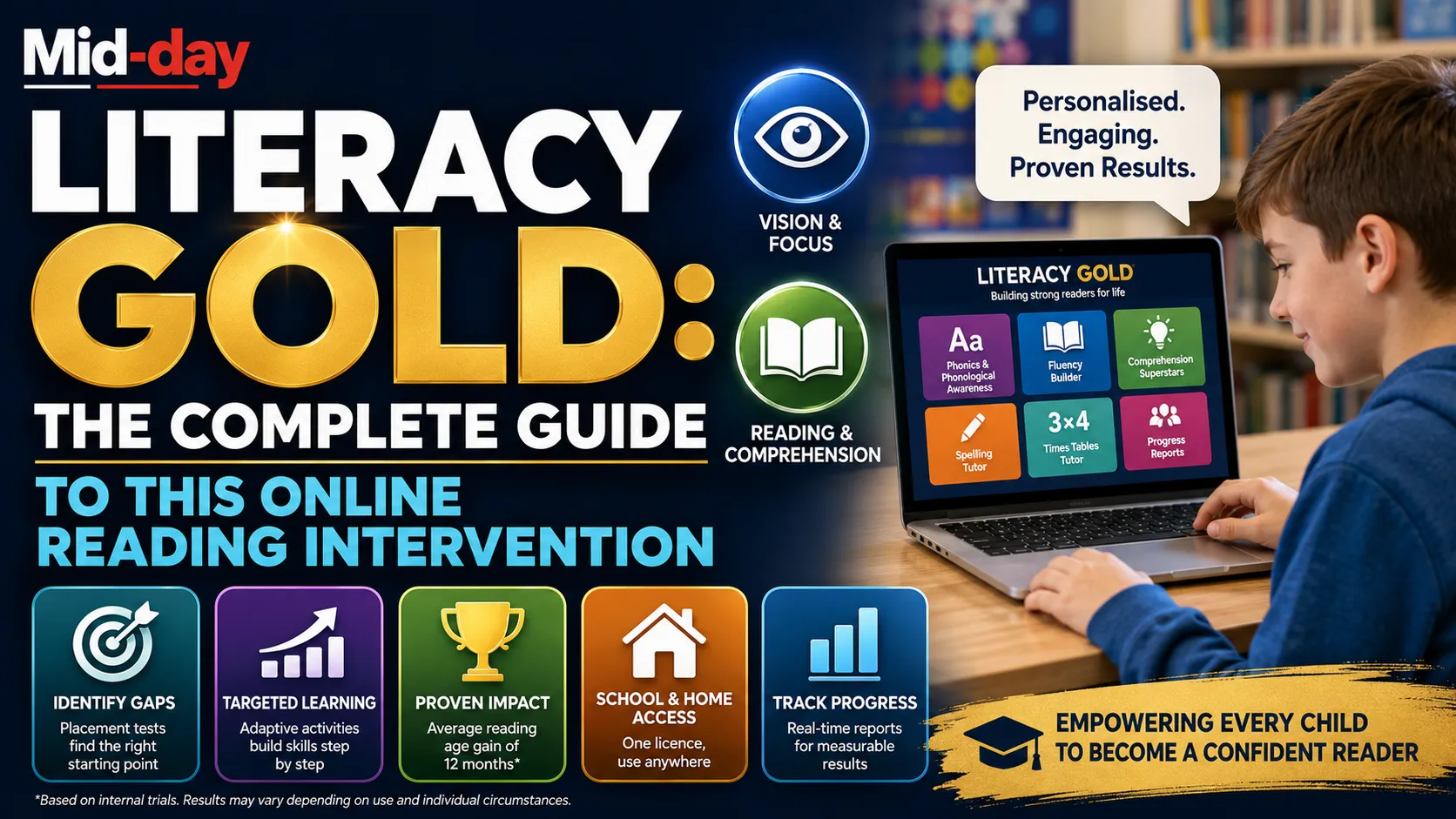
When children fall behind with reading, the gap tends to widen rather than close on its own. Standard phonics teaching helps most learners but consistently leaves a group of pupils behind, particularly those with dyslexia, weak phonological awareness, or difficulties with visual tracking. Literacy Gold was built specifically to reach those pupils through an online reading intervention that can be run without specialist staff, without planning time, and without the usual overhead of setting up a one-to-one program.
This guide covers everything schools, SENCOs, and parents need to know about Literacy Gold: what it is, what it does, how it works in practice, which programs are included, what the evidence says, and how it compares to other reading interventions.
Literacy Gold is an online reading intervention platform for children aged 3 to 14, designed for use in UK primary and secondary schools as well as at home. It is developed and operated by Engaging Eyes Ltd, a company registered in Uxbridge, England (company number 06371157), with contact at literacygold.co.uk.
The platform positions itself as going “beyond phonics,” targeting the pupils that standard phonics teaching does not fully reach. Its approach is built on the recognition that reading difficulties can stem from more than one underlying cause and that effective intervention must address vision, phonological awareness, phonics, fluency, vocabulary, and comprehension together rather than in isolation.
Literacy Gold is used in over 1,000 UK schools and is structured around a suite of separate programs, each targeting a different aspect of reading or literacy development.
England’s primary school curriculum has placed strong emphasis on systematic synthetic phonics since the publication of the Rose Report in 2006 and the introduction of the Phonics Screening Check in 2012. Phonics-first teaching has improved outcomes for the majority of early readers. However, it has not eliminated reading failure, and for a specific group of children, phonics instruction alone is insufficient.
Literacy Gold’s own research identified two recurring reasons why children continue to struggle even after extensive phonics teaching:
Vision difficulties affecting eye coordination. Pupils who skip words or lines, reverse letters, or cannot retain what they have read may have a functional vision problem caused by weak eye muscles. When the eyes do not focus on exactly the same point, the brain receives two slightly different images simultaneously, making stable letter recognition and word-by-word reading physically effortful rather than automatic.
Weak phonological awareness. Phonological awareness is the ability to hear and manipulate the individual sounds within words at an auditory level, independently of written letters. A child who cannot reliably hear that the word “goat” contains three sounds (g, oa, and t) will struggle to apply phonics knowledge fluently, even if they have been taught the letter-sound correspondences correctly in isolation.
Literacy Gold addresses both of these issues directly through targeted programs, which is what distinguishes it from programs that address only one dimension of reading difficulty.
One of Literacy Gold’s most practically significant features for busy schools is that it requires no lesson planning, preparation, or specialist training to run. After a brief placement test that assigns each pupil to the right starting point, the program runs itself. A teaching assistant or any adult can supervise a session without needing to know phonics teaching methodology or reading recovery techniques.
Literacy Gold can be run as a group intervention or used individually. The group model makes it particularly cost-effective as a use of school time, since one adult can support several pupils working simultaneously through the platform. Each pupil follows a personalized path based on their own placement and progress data, so working in a group does not mean all pupils are on the same activity.
The platform includes built-in reading age tests, reading speed assessments, and data reporting tools. Schools can track progress at the individual pupil level, class level, or year group level. Reports include graphs, spreadsheets, and VIPERS (Vocabulary, Inference, Prediction, Explanation, Retrieval, Summarize) comprehension reports. This makes it straightforward to generate evidence of impact for Ofsted inspections, EHCP reviews, or pupil progress meetings.
Literacy Gold explicitly aligns its reporting with Ofsted’s 2025 inspection framework and with the UK government’s Reading Framework, making it easier for schools to demonstrate how their intervention program connects to national expectations.
A school license provides access both on school devices and at home on pupils’ own devices, which means the intervention can continue outside school hours without any additional cost. This is particularly useful for pupils who would benefit from daily short practice sessions beyond the school day.
Literacy Gold is not a single program but a platform comprising several distinct tools, each targeting a specific literacy or learning need.
Engaging Eyes is the vision training programme within Literacy Gold. It uses online games specifically designed to exercise the eye muscles, helping both eyes work together more consistently and reducing erratic eye movements during reading. The connection between functional vision and reading fluency is well-established in optometric and educational research, and this programme addresses a dimension of reading difficulty that most literacy interventions do not touch.
Reading Unlocked is the core phonics and phonological awareness program. It delivers systematic phonics instruction combined with phonological awareness activities, teaching pupils to hear individual sounds in words and to map those sounds onto their written equivalents. Activities are designed to be engaging and game-based, with the program automatically personalizing the sequence to each pupil’s current level.
Fluency Builder targets reading fluency specifically, including the ability to read accurately, at an appropriate speed, and with expression. Pupils record themselves reading, listen back to their own recordings, and receive structured practice on the aspects of fluency they find most challenging. The program is suitable for pupils aged 6 to 12 and focuses heavily on phonological awareness as the foundation for fluent decoding.
Comprehension Superstars covers reading comprehension using the VIPERS framework, which is widely used in UK primary schools for teaching comprehension skills. The six question types covered are Vocabulary, Inference, Prediction, Explanation, Retrieval, and Summarization. The program includes built-in reporting by VIPERS category, making it easy for teachers to see which comprehension skills each pupil needs the most support with.
Spelling Tutor is a structured spelling intervention that reinforces the sound-symbol relationships taught through phonics and applies them to written spelling. It addresses both phonically regular words and common exception words and includes activities that develop the auditory and visual memory components of accurate spelling.
Times Table Tutor is a numeracy tool included within the Literacy Gold platform, using structured game-based practice to develop fluent multiplication fact recall. Its inclusion reflects a recognition that many pupils who struggle with literacy also have difficulties with numeracy fluency and that the same platform can address both.
Literacy Gold includes a dyslexia screener as part of its tools, which provides an initial indication of whether a pupil may have characteristics associated with dyslexia. This is positioned as a first-step screening tool rather than a diagnostic assessment. A formal dyslexia diagnosis requires assessment by a qualified educational psychologist, but the screener can help schools identify pupils who may benefit from further assessment and from Literacy Gold’s targeted intervention programs in the meantime.
Talk Stars is an early years programme designed for children aged 3 and upwards, addressing spoken language development as the foundation for later literacy. Given the well-evidenced relationship between oral language ability at age five and later reading achievement, early language intervention is an increasingly recognized priority for school readiness.
According to Literacy Gold’s own published results, formal trials showed that students’ reading improved by an average of 12 months in a single term when using the program, with spelling improving by an average of 10.5 months in the same period. The platform also reports cases of significantly higher individual gains, with teacher testimonials including one child who showed a reading age improvement of 62 months across two terms.
Staff and pupil feedback collected during trials was described as positive, with both age-appropriateness and engagement highlighted as strengths.
One SENCO quoted on the Literacy Gold site described it as “the single most important and effective program we run at school.” Another described it as the first program they had found that replicates what a specialist teacher would do in a one-to-one intervention while also being fun and targeted.
It is worth noting that the evidence base currently presented on Literacy Gold’s website comes primarily from the company’s own trials and from school testimonials rather than from independently published peer-reviewed research. For schools that require external validation through databases such as the Education Endowment Foundation’s Teaching and Learning Toolkit, it is worth reviewing whether Literacy Gold has been submitted to or evaluated through independent research bodies. Schools are encouraged to run a free trial to gather their own evidence of impact with their specific pupil cohort.
Literacy Gold describes its user base across several distinct categories:
Pupils in KS1 (Years 1 and 2): Building foundational phonics and phonological awareness during the early years of formal reading instruction.
Pupils in KS2 (Years 3 to 6): Intervention for pupils who remain below expected reading age and have not closed the gap through standard classroom teaching.
Pupils in KS3 (Years 7 to 9, secondary school): Secondary schools face a significant challenge with pupils who arrive with low reading ages after years of primary phonics teaching. Literacy Gold’s secondary offer uses age-appropriate content and phrasing to avoid the stigma of younger-seeming materials for older pupils.
Pupils with dyslexia: The platform explicitly addresses the profile of difficulties associated with dyslexia, including weak phonological processing, visual tracking difficulties, and slow processing speed.
Pupils without a diagnosis: Literacy Gold is designed to be suitable for all pupils who struggle with reading, not only those with a formal SEND identification. It works as a general reading intervention as well as a specialist tool for identified needs.
Parents and home use: Literacy Gold offers a separate parent license allowing home use, making it accessible for families who want to support struggling readers outside school.
A few features of Literacy Gold’s approach are genuinely distinctive compared to other commonly used reading intervention tools in UK schools.
The inclusion of vision training is unusual and significant. Most reading intervention programs, including widely used tools such as Reading Recovery, Rapid, or Lexia, do not include a vision training component. The evidence that functional vision difficulties contribute to reading failure in a subset of children is real, and the absence of vision work from the majority of interventions means that children with this specific profile are often left behind even after extensive phonics-based intervention. Engaging Eyes addresses this gap directly.
The “no training required” model is both a strength and a limitation. For schools struggling with staff capacity, a program that any adult can run without specialist training is genuinely valuable. It dramatically reduces the barrier to implementation. The limitation is that program effectiveness ultimately depends on consistent, frequent use. A tool that requires no training can also be deprioritized easily. Schools that embed Literacy Gold most effectively typically assign a specific member of staff to manage the timetabling and oversight, even though the program itself runs automatically.
The group model changes the economics of intervention. One-to-one specialist reading intervention, such as Reading Recovery or a qualified SpLD teacher, produces strong results but is expensive and resource-intensive. Literacy Gold’s group delivery model, where one adult oversees several pupils working simultaneously, makes regular intervention sessions achievable within ordinary school staffing budgets.
Alignment with Ofsted and the Reading Framework is now a practical requirement, not a bonus. Schools under inspection scrutiny need to demonstrate that their curriculum and intervention approaches connect to national frameworks. Literacy Gold’s explicit documentation of alignment with both Ofsted’s 2025 framework and the UK Reading Framework reduces the administrative burden of evidencing this connection.
Not running sessions frequently enough. Literacy Gold works best when pupils complete sessions regularly, ideally several times per week. Schools that timetable it as an occasional activity rather than a consistent short daily or near-daily intervention tend to see slower progress.
Starting without completing the placement test. The placement test is what personalizes each pupil’s program. Skipping it and starting pupils at the beginning regardless of their actual level reduces the efficiency of the intervention and can lead to either frustration or insufficient challenge.
Not using the data reporting tools. The built-in graphs and spreadsheets are designed to make monitoring easy, but they are only useful if someone checks them regularly. Schools that assign a named person to review Literacy Gold data at least half-termly can intervene quickly if a pupil’s progress stalls.
Treating it as a replacement for skilled teaching rather than an intervention. Literacy Gold supplements high-quality classroom reading teaching rather than replacing it. Pupils who are significantly below age-related expectations typically need both strong classroom teaching and structured additional intervention to close the gap within a reasonable timeframe.
Not using the home access feature. A significant proportion of potential benefit from the program is available through home use, which comes at no additional cost on a school license. Schools that communicate this clearly to families and encourage regular home sessions tend to see better outcomes than those that restrict use to school time only.
For schools considering Literacy Gold:
For SENCOs specifically: 6. Use the built-in reading age and speed tests before and after the intervention to generate reportable evidence of impact for EHCP annual reviews or pupil progress meetings. 7. Consider the Dyslexia Screener as a first-step tool for pupils whose teachers suspect may have dyslexia, before pursuing a formal educational psychology referral.
For parents: 8. Ask your child’s school whether they use Literacy Gold and whether the home access feature is active on the school’s license. 9. If purchasing a home license independently, use the parent trial to assess whether the specific programs are well-matched to your child’s particular reading difficulties before subscribing.
Literacy Gold is a practically designed online reading intervention platform that addresses a real and persistent gap in UK school reading provision. By combining vision training, phonological awareness development, phonics teaching, fluency practice, and comprehension work in a single no-preparation platform, it reaches pupils who fall outside the reach of standard phonics-first instruction alone.
Its group delivery model, built-in assessment tools, and alignment with Ofsted and the Reading Framework make it a genuinely viable option for schools looking for an evidence-informed, scalable intervention that does not require specialist staff to run. The absence of independent peer-reviewed trials in the published literature means schools should use their own trial data alongside the company’s impact claims when making subscription decisions.
For any school that has pupils significantly below reading age, particularly those who have already received phonics intervention without sufficient progress, Literacy Gold represents a distinctive and practically accessible option that is worth evaluating on the basis of a structured trial.
What is Literacy Gold? Literacy Gold is an online reading intervention platform for children aged 3 to 14, developed by Engaging Eyes Ltd and used in over 1,000 UK schools. It combines vision training, phonological awareness, phonics, fluency, spelling, and comprehension programs in a single platform that requires no planning, preparation, or specialist training to run.
What age group is Literacy Gold designed for? Literacy Gold covers children aged 3 to 14, with programs suited to Early Years, KS1, KS2, and KS3. This makes it one of the few platforms that bridges from early language development all the way through to secondary school reading intervention.
Is Literacy Gold suitable for pupils with dyslexia? Yes. Literacy Gold is explicitly designed to address the profile of difficulties associated with dyslexia, including weak phonological processing, visual tracking difficulties, and slow processing speed. It includes a dyslexia screener as a first-step identification tool and programs that directly target the underlying causes of reading difficulties associated with dyslexia.
How much does reading improve with Literacy Gold? According to Literacy Gold’s own trials, pupils’ reading improved by an average of 12 months in a single term, with spelling improving by an average of 10.5 months in the same period. These figures are based on the company’s own data; schools are encouraged to run a trial and measure their own cohort’s progress.
How is Literacy Gold different from standard phonics programs? Literacy Gold goes beyond phonics by addressing vision difficulties, phonological awareness, reading fluency, comprehension, and spelling alongside phonics. Standard phonics programs address sound-symbol correspondence but do not include vision training or structured fluency development.
What programs are included in Literacy Gold? Literacy Gold includes engaging eyes (vision training), reading unlocked (phonics and phonological awareness), fluency builder, comprehension superstars, spelling tutor, times table tutor, dyslexia screener, and talk stars (early years language development).
Does Literacy Gold require specialist staff to run? No. Literacy Gold is specifically designed so that any adult can run it without specialist training or lesson planning. After an initial placement test, pupils work through a personalized program independently, with an adult supervising rather than teaching.
Can Literacy Gold be used at home? Yes. A school license includes home access at no additional cost, allowing pupils to continue using the platform outside school hours on their own devices. A parent license is also available for families who want to use the platform independently of their child’s school.
Is there a free trial for schools? Yes. Literacy Gold offers a free six-week school trial through its website at literacygold.co.uk, with no charge unless the school chooses to subscribe after the trial period ends.
Who makes Literacy Gold? Literacy Gold is developed and operated by Engaging Eyes Ltd, a company registered in Uxbridge, England. The company’s registered number is 06371157. Contact is available at info@literacygold.co.uk or by phone at 01895 546 254.





[…] This guide explains exactly what APBET is, how these schools work, why they exist, what challenges they face, and the current legislative push to integrate them formally into Kenya’s national education system. […]