Physical Address
304 North Cardinal St.
Dorchester Center, MA 02124
Physical Address
304 North Cardinal St.
Dorchester Center, MA 02124

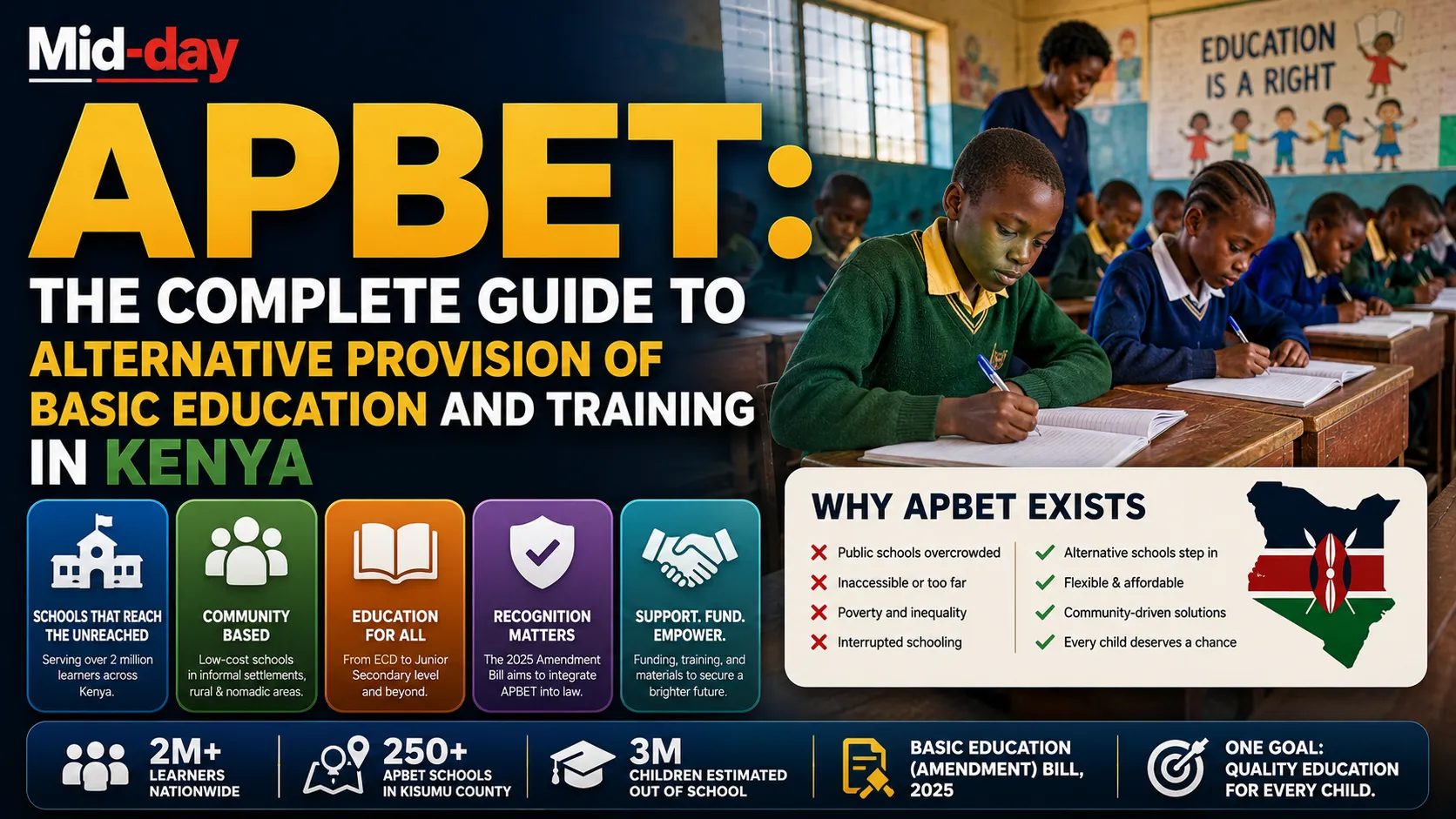
More than two million children and young people in Kenya attend schools that the government has not yet formally recognized. They sit in classrooms in Nairobi’s Kibra, Mathare, and Kawangware informal settlements, in fishing communities on Lake Victoria, in arid and semi-arid areas of the northern counties, and in dozens of other places where public schools are oversubscribed, physically inaccessible, or otherwise unable to serve the children living nearby. The institutions serving these learners operate under the framework of Alternative Provision of Basic Education and Training, commonly known by its acronym APBET.
This guide explains exactly what APBET is, how these schools work, why they exist, what challenges they face, and the current legislative push to integrate them formally into Kenya’s national education system.
APBET stands for Alternative Provision of Basic Education and Training. It is the official policy framework in Kenya that governs non-formal and informal educational institutions providing basic education to children, youth, and adults who are unable to access formal public schooling.
The term was introduced through Kenya’s Policy for Alternative Provision of Basic Education and Training, issued by the Ministry of Education in May 2009. This policy replaced earlier approaches based on what was known as Non-Formal Education (NFE) and represented a formal government acknowledgment that a large segment of the Kenyan population required educational provision different from the mainstream public school model.
APBET schools, also called APBET institutions or APBET centers, are community-based, low-cost schools that provide education from early childhood development (ECD) through junior secondary school level. They primarily serve children and young people from low-income households in areas where public school options are physically inaccessible, severely overcrowded, or simply do not exist.
These institutions are distinct from both public schools (funded and staffed by the government) and registered private schools (fee-charging, regulated institutions). APBET schools typically charge minimal or flexible fees, often accepting in-kind contributions or adjusting payments to family circumstances, since their learners come from households that cannot afford formal private school fees but are not adequately served by the public system.
The Ministry of Education’s 2009 policy identified several types of institutions that fall under the APBET category:
The existence of APBET schools reflects a structural gap between Kenya’s constitutional commitments on education and the actual capacity of its public school system.
Kenya’s Constitution of 2010 guarantees the right to education under Article 43 and specifically provides in Article 53(b) that every child has the right to free and compulsory basic education. The Basic Education Act of 2013 implements this commitment, with Section 39(c) specifically mandating the Cabinet Secretary for Education to ensure that children from marginalized, vulnerable, or disadvantaged groups are not hindered from pursuing basic education.
Despite these commitments, the expansion of Free Primary Education (FPE) from 2003 and Free Day Secondary Education (FDSE) from 2008 did not fully close the access gap. Urban informal settlements, arid and semi-arid regions, and impoverished rural areas continued to be underserved. The 2007 Kenya National Adult Literacy Survey found that 7.8 million Kenyans were illiterate, with those aged 15 to 30 accounting for 35 percent of the illiterate population.
In response to this unmet need, community members, local organizations, religious groups, and individual proprietors established informal schools in their own communities. These institutions grew organically out of a recognized need, operating long before any formal policy framework acknowledged their existence.
The numbers tell a significant story about how important APBET institutions are to Kenya’s education landscape.
Nationally, more than two million learners are enrolled in APBET schools, according to data reported by the Kenya News Agency in March 2026. In Kisumu County alone, John Ochieng, the county’s APBET chairman, reported more than 250 APBET schools serving tens of thousands of learners from informal settlements, including Manyatta, Obunga, and Nyalenda.
In the Kibra constituency in Nairobi, Member of Parliament Peter Orero told Parliament in April 2026 that APBET institutions significantly outnumber public schools in the constituency, meaning that a majority of students in his area end up in APBET schools rather than the formal public system.
The Basic Education (Amendment) Bill, 2025, brought to Parliament by Mathare MP Anthony Oluoch, cited nearly three million children as remaining outside the formal education system, many of whom attend APBET institutions that fall outside the National Education Management Information System (NEMIS).
The foundational document is the Policy for Alternative Provision of Basic Education and Training, published by Kenya’s Ministry of Education in May 2009. This policy established the conceptual framework for APBET, defined the types of institutions eligible for the designation, and set out initial guidelines for registration and recognition.
The Basic Education Act of 2013 is the primary legislation governing all forms of basic education in Kenya. However, APBET schools have faced a critical legal problem: the Basic Education Act of 2013 as originally enacted only formally recognized public and private schools. APBET institutions were not explicitly included within the Act’s definitions, which created the paradox of a policy framework acknowledging these schools while the primary legislation governing basic education did not formally include them.
This legal gap has had severe practical consequences. Because APBET schools are not recognized under NEMIS, their learners cannot be registered in the national system, which bars them from accessing government capitation funds under the Free Primary Education program and prevents their learners from being registered for national examinations.
The Ministry of Education’s registration guidelines for APBET institutions require schools to comply with minimum standards covering curriculum, teaching and learning, school management, facilities, and student outcomes before qualifying for registration. These requirements, though reduced from the full standards applied to formal private schools, have proven difficult for many APBET institutions to meet given their resource constraints.
A 2018 national mapping and registration exercise conducted by the Ministry led to the gazettement of some APBET institutions in certain counties, including a number in Kisumu. However, implementation has been uneven, and as of 2026, major urban counties, including Nairobi, Mombasa, and Nakuru, had not completed the registration process. In Kisumu, only 31 APBET schools out of more than 250 operating in the county were registered and recognized.
The most significant current development in APBET policy is the Basic Education (Amendment) Bill, 2025, sponsored by Mathare MP Anthony Oluoch and supported by a broad coalition of Members of Parliament across parties.
The bill, which received backing from MPs across the chamber in debates during April 2026, proposes the following specific reforms:
The bill was described by Deputy Speaker Gladys Boss as a measure that would strengthen inclusivity in the national education system. Ruaraka MP Tom Kajwang’ warned Parliament that the continued lack of recognition actively limits APBET learners’ ability to transition to higher levels of education.
If passed, the bill would be the most significant legislative change to the status of APBET schools since the original 2009 policy was issued.
APBET schools are operated by a diverse range of proprietors. They include individual community members, local NGOs, faith-based organizations, private individuals who established schools out of local need, and community groups.
The Unified APBET Schools Association of Kenya (UASA-Kenya) is the primary national membership body representing APBET school proprietors. According to its own description, UASA-Kenya is an association of low-cost private school proprietors operating as APBET schools, whose role is to complement the government’s effort in providing and expanding access to quality education for all.
The UASA-Kenya was launched with a specific focus on advocacy for formal recognition, funding access, and improved policy support from both the national government and county governments. Its national chairman, Moses Wokono, has been an active voice in parliamentary advocacy and public campaigns for APBET recognition.
At the county level, county APBET chairmen and regional associations represent the sector in engagements with county education directors and local authorities. The Nairobi City County licensing authority has been engaged in reducing the business license costs that APBET schools are required to pay, which had stood at KSh 10,000. Commitments were made in 2023 to reduce this to KSh 3,000 in the county finance bill.
The operational challenges facing APBET schools are well-documented across multiple sources, including the Kenya News Agency, Teachers Updates, education advocacy organizations, and parliamentary debates.
The most structurally significant challenge is the exclusion of APBET learners from NEMIS and from government capitation funding. Schools that have not completed the registration process cannot access FPE funding, even when they serve exactly the population FPE was designed to reach. This creates the paradox of public money earmarked for universal basic education failing to reach the children who need it most.
The transition to Kenya’s Competency-Based Curriculum (CBC) has created a significant new challenge for APBET schools. CBC learning materials are not officially distributed to unregistered APBET institutions. Textbooks, which cost between KSh 600 and KSh 1,000, are largely unaffordable for most parents. In many APBET schools, a single copy of a textbook is shared among multiple learners, and teachers rely on photocopied or digital versions where internet access permits.
Before the COVID-19 pandemic, some APBET schools received partial support through government teacher deployment programs. These programs have since been suspended, and most APBET schools now rely on NGO-supported or volunteer teachers. Teacher training initiatives that had helped some APBET teachers implement CBC have also been discontinued, affecting the quality of curriculum delivery.
APBET schools operate in a wide variety of settings, from purpose-built community buildings to converted residential spaces. Overcrowded classrooms are common, and many institutions lack adequate sanitation, water supply, and age-appropriate learning environments.
One of the most severe consequences of the recognition gap is in learner transition. Because APBET learners are not registered in NEMIS, they face significant barriers to being placed in government secondary schools and to sitting national examinations. Many learners who complete junior secondary school in an APBET institution are unable to progress to senior secondary education because the system does not formally recognize their prior schooling. Kisumu County APBET chairman John Ochieng reported in 2026 that many learners drop out after Grade 9 due to unaffordable fees, uniform costs, and placement limitations attributable directly to their unrecognized status.
A 2024 report by the Global Initiative for Economic, Social, and Cultural Rights (GI-ESCR) analyzed APBET schools using the Abidjan Principles on the Right to Education as a framework. The report explored the legal and policy framework governing public, private, APBET, and community schools in Kenya and recommended policy measures to improve access to quality education for all children.
The Abidjan Principles, formally titled the Guiding Principles on the Human Rights Obligations of States to Provide Public Education and to Regulate Private Involvement in Education, provide an internationally grounded framework for analyzing whether state treatment of different school types respects human rights obligations. The GI-ESCR report recommended aligning Kenya’s APBET policy with these principles to ensure that the formal recognition of APBET institutions strengthens rather than undermines the state’s obligations to provide free, quality public education.
This analysis highlights a genuine tension in APBET policy: formalizing APBET schools could reduce pressure on the government to expand public school provision in underserved areas, or it could create a legitimate, funded channel for extending access to communities where public provision alone is insufficient. How the Basic Education (Amendment) Bill, 2025, addresses this tension will be critical to its long-term impact.
The National Council for Nomadic Education in Kenya (NACONEK) has also taken on an enhanced role in relation to APBET, with the pilot mapping of APBET institutions in Nairobi, Mombasa, and Kisumu forming part of NACONEK’s institutional mandate.
“APBET schools are illegal.” Many APBET schools operate legitimately under the 2009 policy framework and county licensing requirements, even where they have not yet completed the full registration process under the Basic Education Act. Their unregistered status reflects the incompleteness of a government process rather than illegality in every case, though the legal position is genuinely complex and contested.
“APBET schools are low quality and should be closed.” The quality of APBET schools varies significantly, and some are highly effective community institutions serving children who would otherwise have no educational options. The appropriate response to quality variation is regulated improvement and support, not blanket closure, as confirmed by the parliamentary consensus around the 2025 Amendment Bill.
“This only affects a small number of children.” With more than two million learners in APBET institutions nationally and estimates reaching three million by some counts, this affects a substantial proportion of Kenya’s school-age population and is a mainstream policy concern rather than a niche issue.
“The government’s position has not changed since 2009.” The introduction of the Basic Education (Amendment) Bill, 2025, and the broad parliamentary support it received in 2026 represent a meaningful shift in political will toward formal integration of APBET institutions. The policy landscape is more active in 2026 than at any previous point.
For APBET school proprietors:
For parents of children in APBET schools: 4. Enquire whether your child’s school is registered with the Ministry of Education. Registered APBET institutions provide learners with a clearer pathway to national examinations and secondary school placement. 5. Engage with the school management on CBC curriculum materials, as NGO and community partnerships can sometimes provide access to materials that individual schools cannot afford independently.
For researchers and policy analysts: 6. The GI-ESCR report and NACONEK mapping data provide the most rigorous current evidence base on APBET institutions. Parliamentary Hansard records from the April 2026 debates on the Basic Education (Amendment) Bill provide the most up-to-date legislative perspective.
APBET, or Alternative Provision of Basic Education and Training, represents the backbone of educational access for millions of Kenyan children and young people who fall outside the reach of the formal public school system. These schools exist because the demand for education in Kenya’s informal settlements, nomadic communities, and underserved regions exceeds what the formal public system currently delivers.
The challenge they face is structural: they operate under a policy framework that acknowledges their importance while the primary legislation governing basic education has not formally included them, blocking their learners from government funding and national examination access. The Basic Education (Amendment) Bill, 2025, if passed, would be the most significant step toward resolving this gap since the original APBET policy was issued in 2009.
Whether Kenya’s parliament chooses to formally integrate APBET institutions, and on what terms, will determine the educational prospects of millions of children who have no other realistic schooling option.
What does APBET stand for? APBET stands for Alternative Provision of Basic Education and Training. It is a Kenyan government policy framework governing informal and non-formal schools serving children and communities unable to access formal public schooling.
What are APBET schools in Kenya? APBET schools are community-based, low-cost institutions providing education from early childhood development through junior secondary school level. They primarily serve children from low-income households in urban informal settlements, arid and semi-arid areas, and other underserved communities.
How many children attend APBET schools in Kenya? More than two million learners nationally attend APBET institutions, according to the Kenya News Agency reporting from March 2026. Some parliamentary estimates from 2026 cite figures approaching three million.
Are APBET schools legal in Kenya? Many APBET schools operate under the 2009 Ministry of Education policy framework and hold county business licenses. However, the Basic Education Act of 2013 as originally enacted did not formally include APBET institutions, creating a legal gap. The Basic Education (Amendment) Bill, 2025, aims to resolve this by formally integrating APBET schools into the national legal framework.
Why are APBET schools not funded by the government? APBET schools that are not registered under the National Education Management Information System (NEMIS) cannot access government Free Primary Education capitation funds. Registration requires compliance with Ministry of Education guidelines, and the registration process has been incomplete across most counties. Only 31 of Kisumu’s 250-plus APBET schools were registered, and even those were not receiving government support as of 2026.
What is the Unified APBET Schools Association of Kenya? The Unified APBET Schools Association of Kenya (UASA-Kenya) is the national membership body representing APBET school proprietors. It advocates for formal government recognition, funding access, and improved policy support for APBET institutions.
What is the Basic Education (Amendment) Bill, 2025? The Basic Education (Amendment) Bill, 2025, is a proposed law sponsored by Mathare MP Anthony Oluoch that would formally incorporate APBET institutions into the Basic Education Act of 2013. It proposes to include APBET schools in the statutory definition of basic education, provide them with representation on the National Education Board, and create funding mechanisms for infrastructure and learning materials.
What challenges do APBET schools face? Key challenges include exclusion from government funding and NEMIS registration, lack of access to CBC learning materials, shortage of trained teachers, overcrowded and inadequate facilities, and barriers preventing learners from transitioning to formal secondary education.