Physical Address
304 North Cardinal St.
Dorchester Center, MA 02124
Physical Address
304 North Cardinal St.
Dorchester Center, MA 02124


Most small and mid-sized businesses sit on a mountain of data they never actually use. Sales numbers, inventory levels, customer activity, marketing spend, all of it scattered across QuickBooks, Shopify, a CRM, and a handful of spreadsheets, with nobody available to turn it into a usable answer when a decision needs to be made today. INSIQ was built specifically to close that gap by letting anyone ask a plain-English question about their business data and get an instant, data-backed answer.
This guide explains exactly what INSIQ is, how it works, who it is built for, how it compares to traditional business intelligence tools and generic AI chatbots, and how to get the most out of it if you decide to use it.
INSIQ is an AI-powered conversational business intelligence platform developed by Connexical Limited. Its core function is to let users ask business questions in plain English and receive instant, data-backed answers in the form of charts, forecasts, and executive reports, without having to write SQL queries or build dashboards manually.
The platform connects to a business’s existing software and databases, automatically maps the structure of that data using AI, and then answers natural language questions by querying the live data directly. Currently positioned as a conversational business intelligence tool in beta, INSIQ is designed to work across any industry and any database schema, rather than requiring industry-specific templates or extensive setup.
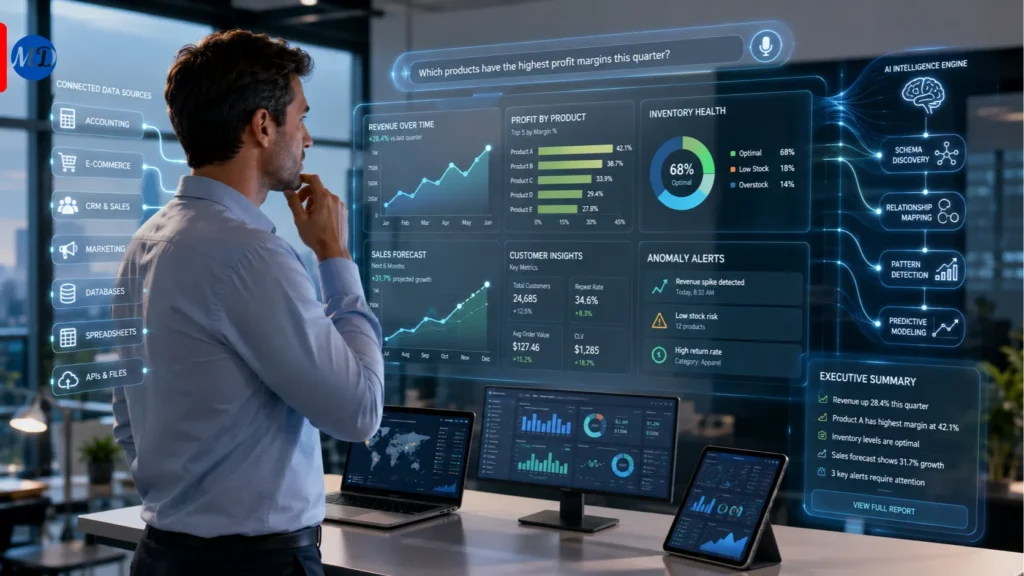
Traditional business intelligence tools, such as Tableau or Power BI, are powerful but require significant setup time, technical skill, and often a dedicated analyst to build and maintain dashboards. For smaller businesses without a data team, this creates a real bottleneck: someone has a question about the business, but getting an answer means waiting on IT, learning SQL, or hiring outside help.
At the same time, generic AI chatbots like ChatGPT or Claude can answer questions conversationally, but they are not connected to a business’s live, private data by default. Asking a general AI assistant about your store’s margins last quarter will not produce an accurate answer unless that data has been manually provided in the conversation.
INSIQ positions itself directly between these two categories. It offers the plain English query experience of a chatbot, combined with a direct, live connection to the business’s actual data, the way a traditional BI platform would, but without the setup overhead.
INSIQ connects to more than 30 data sources without requiring custom configuration. According to the platform’s own documentation, supported integrations span several categories:
For any data source not natively supported, INSIQ states that any REST API or inbound webhook can be connected directly, extending coverage beyond the pre-built integration list.
Once a data source is connected, INSIQ automatically profiles every table, detects relationships between them, and maps the semantic meaning of the data using AI. This step is what removes the traditional BI setup burden. Instead of a person manually defining what each column or table represents, the platform infers this structure on its own, whether the underlying schema is a standard accounting database or a fully custom, proprietary system.
With the data connected and mapped, users interact with INSIQ through natural language. Typing a question such as “which store had the best margins last quarter” or “show me slow-moving inventory across all locations” prompts the system to query the live data directly and return a chart alongside a written narrative explanation.
The platform’s stated design principle is that it does not fabricate or estimate numbers. If a question cannot be answered because the relevant data does not exist in the connected source, INSIQ is designed to say so directly rather than generating a plausible-sounding but unverified answer. This distinction is central to how the platform differentiates itself from general-purpose AI chatbots, which can produce confident-sounding answers that are not actually grounded in real data.
The foundational feature is the ability to ask any business question in plain English and receive a data-backed answer with a live chart, follow-up suggestions, and a downloadable report.
INSIQ automatically profiles connected databases, detects table relationships, and maps semantic meaning without manual configuration, regardless of whether the schema is industry-standard or fully custom.
The platform offers forecasting models that can project future revenue, growth, and sales trends. This functionality is designed to work on any numeric business metric rather than being restricted to a fixed set of predefined KPIs.
Users can set thresholds for specific metrics and receive notifications when, for example, revenue drops below a target or stock runs low. This shifts some monitoring from manual checking to automated notification.
For businesses operating across multiple locations, INSIQ allows questions to be scoped to a single branch, compared across branches side by side, or analyzed at the full company level. Branch scoping is applied automatically according to a user’s role and permissions.
A one-click executive summary feature generates a comprehensive business report covering revenue, customers, products, branches, trends, anomalies, and recommendations in a single document.
Reports can be configured to run automatically on a daily, weekly, or monthly basis, regenerating with fresh data and emailing the results without manual intervention.
Generated reports can be shared via a public link or embedded as iframes within internal wikis, intranets, or other internal tools, with access controlled through tokens.
INSIQ is designed to serve businesses across a range of industries without requiring industry-specific setup. Based on the platform’s own use case documentation, it is positioned for:
The common thread across these use cases is a business with meaningful operational or transactional data spread across multiple systems, and a need for fast answers without dedicated analyst support.
INSIQ offers a tiered subscription model based on monthly token allocation, which corresponds to a defined number of AI queries.
| Plan | Monthly Cost | Tokens | Approximate Queries | Seats | Key Features |
|---|---|---|---|---|---|
| Spark | Free forever | 500 | ~10 | 1 | AI chat and charts, dashboard, CSV import, prompt library |
| Starter | $29/mo | 5,000 | ~50 to 100 | 2 | All Spark features, plus report builder and saved reports |
| Growth | $79/mo | 15,000 | ~150 to 300 | 5 | All Starter features, plus database connectors, multi-branch support, report sharing, insights feed |
| Business | $199/mo | 50,000 | ~500 to 1,000 | 15 | All Growth features, plus forecasting, anomaly detection, alerts, targets, morning briefings, customer segmentation, executive summaries |
| Enterprise | Custom | 150,000 | ~1,500 to 3,000 | Unlimited | All Business features, plus white-label branding, API access, dedicated support, SLA guarantee |
The Spark plan is free indefinitely, with no credit card required, while all paid plans include a 14-day free trial. Annual billing offers a 17 percent discount compared to paying monthly.
Understanding where INSIQ sits relative to other tools clarifies what kind of need it is actually built to address.
| Capability | INSIQ | Tableau / Power BI | ChatGPT / Claude | Traditional ERP Reports |
|---|---|---|---|---|
| Plain English queries | Yes | No | Yes | No |
| Connected to live business data | Yes | Yes | No | Yes |
| AI schema auto-discovery | Yes | No | No | No |
| Works with any database schema | Yes | No | No | No |
| Setup time | Minutes | Weeks | Minutes | Weeks |
| Requires SQL or technical skills | No | Yes | No | No |
| Forecasting and anomaly detection | Yes | Yes | No | No |
| Multi-branch scoping | Yes | Yes | No | Limited |
The key distinction is that traditional BI platforms like Tableau and Power BI offer powerful, connected analytics but require significant setup time and technical expertise to configure dashboards. General AI chatbots offer conversational ease but lack a direct, live connection to private business data by default. INSIQ’s positioning is built around combining the ease of the former with the connectivity of the latter.
The shift toward conversational business intelligence reflects a broader pattern in how software is becoming more accessible to non-technical users, but it is worth understanding what this shift actually changes and what it does not.
It changes who can ask questions, not what data exists. A conversational BI tool like INSIQ does not generate new business insight out of nothing. It removes the technical barrier between a person with a question and the data that already exists in their systems. The quality of the answer is still entirely dependent on the quality and completeness of the underlying connected data.
Schema auto-discovery is the technically hardest part to get right. Any vendor can claim to support natural language queries. The genuinely difficult engineering problem is correctly inferring what a business’s specific, often messy or non-standard database actually represents, without requiring a human to manually map every table and column. This is the feature most worth scrutinizing during any trial, since its accuracy directly determines whether the rest of the platform is trustworthy.
The “no hallucination” claim deserves real-world testing, not just trust. Any platform claiming it never fabricates numbers is making a strong promise. The right way to evaluate this claim in practice is to ask a question you already know the answer to from your own records, and check whether the platform’s response matches exactly. Running this kind of spot check during a trial period is a more reliable way to build confidence than simply taking the vendor’s stated design philosophy at face value.
Token-based pricing changes how you should think about usage. Because INSIQ pricing is built around a monthly token allocation tied to approximate query counts, businesses evaluating the platform should estimate their realistic monthly question volume before choosing a tier, rather than defaulting to the lowest available plan and discovering mid-month that they have run out of capacity.
Connecting every possible data source on day one. It is tempting to connect every available integration immediately, but this can slow down the schema mapping process and make it harder to verify accuracy. Start with the one or two data sources most central to your decision-making, confirm the answers are accurate, and expand from there.
Treating the platform as a replacement for data hygiene. Conversational BI tools query existing data as it actually is. If your CRM data is poorly maintained or your inventory records are inconsistent, the answers you receive will reflect those underlying problems. No AI layer fixes bad source data.
Skipping the verification step during a trial. Given that the entire value proposition rests on accuracy, the most important thing to do during any trial period is to ask questions you can independently verify against your own existing reports, rather than only asking exploratory questions you cannot easily check.
Underestimating query volume needs. Choosing the free Spark tier or a lower-tier paid plan without estimating how many questions your team will realistically ask in a month can lead to running out of tokens at an inconvenient time, particularly for teams that adopt the tool quickly across multiple users.
Ignoring permission and branch-scoping settings in multi-location businesses. For businesses with multiple branches, properly configuring role-based access and branch scoping from the outset prevents confusion later about who can see consolidated company-wide data versus single-location data.
INSIQ represents a practical approach to a problem many businesses without dedicated data teams face every day: data exists, but turning it into a usable answer at the moment a decision needs to be made is often too slow or too technically demanding. By combining AI-driven schema auto-discovery with plain English querying and a direct connection to over 30 common business data sources, INSIQ aims to remove that friction without requiring SQL skills or weeks of dashboard configuration.
As with any platform, making strong claims about data accuracy, the right approach is to test those claims directly during the free trial period rather than accepting them on faith. For businesses with messy or non-standard data structures spread across multiple systems, the schema auto-discovery feature in particular deserves close evaluation before committing to a paid plan.
What is INSIQ? INSIQ is an AI-powered conversational business intelligence platform developed by Connexical Limited. It lets users ask business questions in plain English and receive instant, data-backed answers with charts, forecasts, and reports by connecting directly to a business’s existing data sources.
How does INSIQ work? INSIQ connects to over 30 data sources, including accounting platforms, e-commerce systems, CRMs, marketing tools, and databases. It then uses AI to automatically discover and map the structure of the connected data, allowing users to ask questions in natural language and receive answers generated directly from their live data.
Is INSIQ free to use? INSIQ offers a free forever plan called Spark, which includes about 10 AI queries per month, a full dashboard, CSV import, and a prompt library, with no credit card required. Paid plans start at $29 per month and include a 14-day free trial.
Does INSIQ work with my specific industry? According to the platform, INSIQ uses AI-powered schema auto-discovery to understand any database structure, including retail, healthcare, manufacturing, logistics, hospitality, and SaaS businesses, without requiring industry-specific templates or setup.
Does INSIQ make up or estimate data it does not have? INSIQ states that it does not fabricate numbers and that if requested data does not exist in the connected source, it will say so directly rather than generating an estimated or invented figure. Users evaluating the platform should verify this claim directly by testing it against known data during a trial.
Can INSIQ handle multiple business locations? Yes. INSIQ supports multi-branch businesses by allowing questions to be scoped to a single location, compared across multiple locations, or analyzed at the full company level, with access controlled through user roles and permissions.
How is INSIQ different from Tableau or Power BI? Tableau and Power BI are established business intelligence platforms that offer powerful analytics but typically require significant setup time and technical skill to build dashboards. INSIQ is designed around natural language queries and AI-driven schema mapping, aiming to reduce setup time from weeks to minutes.
How is INSIQ different from using ChatGPT or Claude directly? General AI chatbots are not connected to a business’s live, private data by default and cannot independently query a company’s database. INSIQ is built specifically to connect directly to business data sources and answer questions grounded in that live data.
What data sources can I connect to INSIQ? INSIQ supports more than 30 integrations across accounting platforms such as QuickBooks, Xero, and Sage, e-commerce platforms such as Shopify and WooCommerce, CRM tools such as HubSpot and Salesforce, marketing platforms such as Google Analytics and Meta Ads, databases such as MySQL and PostgreSQL, and file sources such as Google Sheets and CSV uploads. Any REST API or webhook can also be connected.
Is my data secure with INSIQ? According to the platform, INSIQ uses industry-standard encryption in transit and at rest, queries data in real time rather than copying it, and isolates each tenant’s data through database scoping, with all queries logged for audit purposes.




[…] the administrative burden of paper- and spreadsheet-based systems. Its clients are primarily businesses with large numbers of shift-based or hourly workers, particularly in sectors such as retail, […]