Physical Address
304 North Cardinal St.
Dorchester Center, MA 02124
Physical Address
304 North Cardinal St.
Dorchester Center, MA 02124

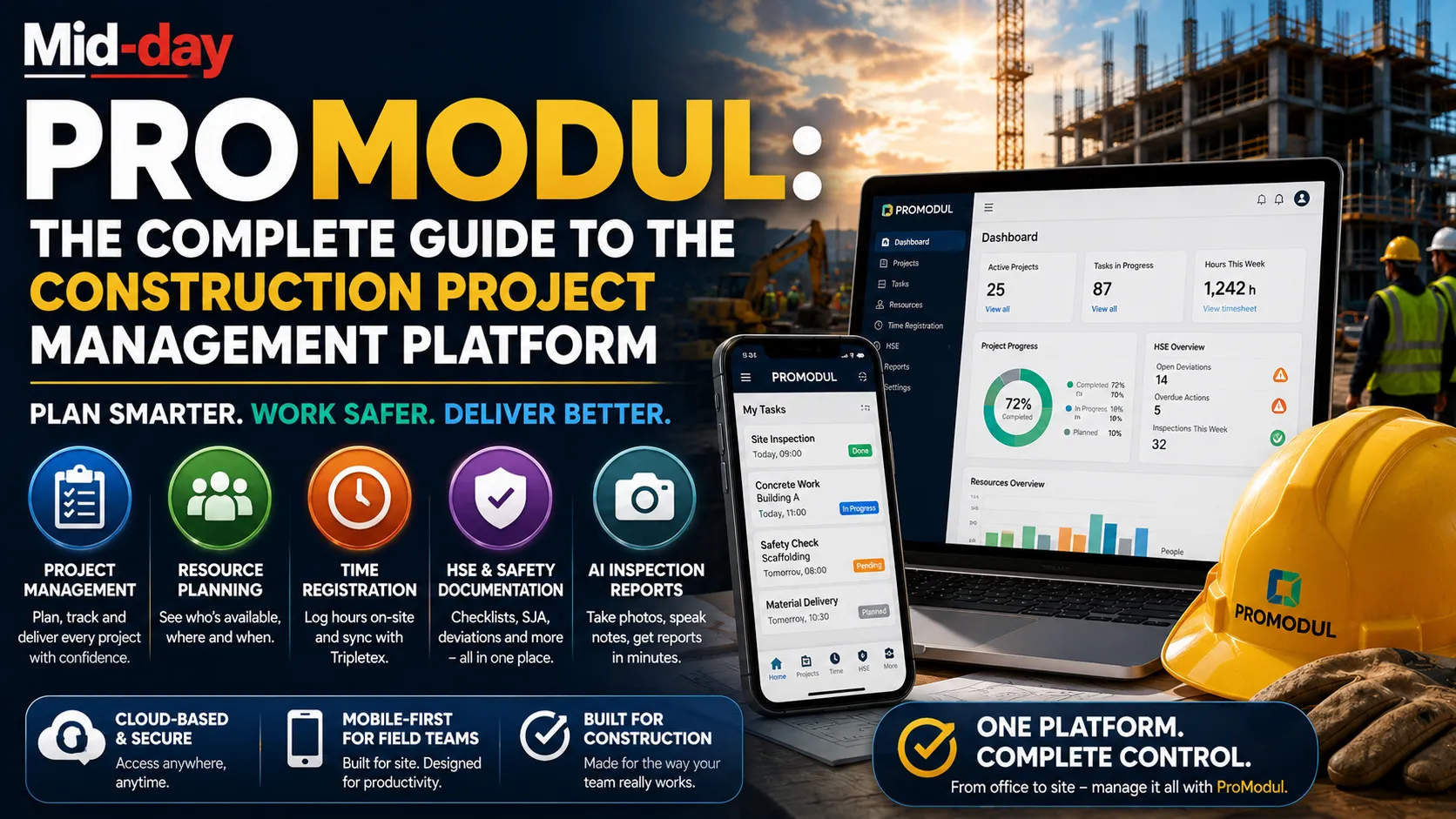
Managing a construction project involves more moving parts than most software tools are designed to handle. You have subcontractors, employees on multiple sites, safety documentation requirements, deviations to track, and clients who need progress reports, all running simultaneously. Most generic project management tools, built for office teams managing digital tasks, handle very little of this well.
ProModul was built specifically for this environment. It is a Norwegian project planning, resource management, and HSE (Health, Safety, and Environment) platform developed for the construction and civil engineering industry, with a mobile-first design for teams working between the office and the job site.
This guide covers what ProModul is, what it does, how it is structured, who it is designed for, and how it compares to the generic project management tools that construction businesses often try and find lacking.
ProModul is a cloud-based project management and HSE system developed by Promodul AS, a company incorporated in Norway on January 31, 2021, with company registration number 926624040. The company is based at Steinslandsvegen 33, 5650 Tysse, Norway, and is reachable at +47 41 14 07 00 and arild@promodul.no.
The platform’s own description positions it as a complete solution for project management, resource planning, time registration, and HSE documentation, tailored to construction and civil engineering (bygg og anlegg in Norwegian). It is available as a web application at app.promodul.no and as a mobile app for Android on Google Play, with iOS support also available.
ProModul’s stated purpose is to give construction businesses full control over their projects, resources, hours, and documentation in one unified system, accessible both from the office and on the job site.
Construction and civil engineering companies face a combination of operational challenges that generic business software handles poorly.
The work happens in the field, not in an office. Progress depends on people who may be moving between three different sites in a week, using a phone more than a laptop. Documentation requirements, including HSE records, deviation reports, checklists, and work permits, are substantial and legally required in many jurisdictions, but collecting them from field workers in real time has traditionally been slow and paper-dependent.
Resource allocation across multiple simultaneous projects is another recurring difficulty. Knowing which employees are assigned to which project, which projects are understaffed, and where bottlenecks are forming requires visibility that spreadsheets and generic calendar tools do not provide well at scale.
Finally, the gap between the job site and the office creates coordination friction. A project manager in an office needs to know what is happening on three different construction sites, and field workers need to access their schedules, complete their safety documentation, and report deviations without needing to call the office for every step.
ProModul addresses all three of these problems within a single platform.
ProModul is structured around a set of integrated functional areas, which can be accessed as part of the standard package or selected as optional add-on modules depending on the business’s needs.
The project planning core lets users create and manage multiple projects simultaneously, with full visibility of status, team assignments, and progress. Projects can be started from scratch or built from pre-configured templates with tasks already set up, which reduces setup time for recurring project types.
Each project can be broken down into tasks with assigned employees, deadlines, and status tracking. The visual planning interface provides an overview of all ongoing, upcoming, and completed projects in one view.
Resource planning is one of ProModul’s distinguishing features. The platform provides a monthly calendar view showing which employees are allocated to which projects across the organization, making it possible to see resource availability and avoid over-scheduling at a glance.
Teams and departments can be organized within the system, and managers can see employee assignments across projects simultaneously rather than having to check each project separately. The mobile app gives individual employees direct access to their own task assignments and schedules without needing to call in for updates.
An integrated time registration feature, described by the company as a recent addition, allows employees to log hours directly from the mobile app. Key capabilities include recording overtime, adding hours to a time bank, submitting hours for approval, and integration with the Tripletex accounting and invoicing platform for seamless billing.
This integration between field time recording and the back-office billing system reduces the manual step of transferring hours from one system to another, which is a common source of error and administrative overhead in smaller construction businesses.
ProModul includes a dedicated HSE module covering safety checklists, Safe Job Analysis (SJA in Norwegian, equivalent to a pre-task risk assessment), deviation registration, and documentation management. All of this is designed to be completed directly from the job site via the mobile app rather than on paper forms that need to be transcribed later.
For construction businesses in Norway and the broader Scandinavian market, HSE documentation is legally required under the Working Environment Act (Arbeidsmiljøloven) and associated regulations. Having this documentation integrated into the same platform used for project and resource management eliminates the common situation where safety records exist in one system, hours in another, and project status in a third.
One of ProModul’s newer features is AI-powered inspection reporting. The workflow allows a field worker to take photos of the site, speak comments into the device, and have a completed inspection report generated automatically. According to the company’s own documentation, this feature delivers a completed report in under five minutes and is described as producing 94 percent faster documentation compared to manual reporting.
This addresses a long-standing friction point in construction documentation: field workers who are good at their physical trade are often reluctant to spend significant time completing written reports. An AI-assisted workflow that converts voice and photos into a structured report directly lowers this barrier meaningfully.
ProModul provides a built-in savings calculator (sparekalkulator) on its website that allows businesses to estimate the time and cost savings from digitizing their current administrative processes. This tool is worth using during evaluation, as it provides a specific financial basis for comparing the cost of the subscription against the quantified administrative overhead it replaces.
ProModul’s platform is specifically designed for and marketed to businesses in the Norwegian construction and civil engineering sector. Client logos on the company’s website include Brann og Sprinkler Teknikk AS, Nebbenes, Mesterbygg, Byggeselskapet AS, Proff Installasjon AS, Ventis, Kvadro Maskin AS, Brovold VVS, Leka Bygg AS, and BS Vest, representing a range of construction, mechanical, and technical installation companies.
The platform is used across project types ranging from individual building projects to multi-site civil engineering work and across company sizes from smaller specialist contractors to larger construction firms with multiple departments.
Understanding where ProModul fits relative to the general project management category clarifies who it is and is not suited for.
| Feature | ProModul | Generic PM tools (e.g. Monday.com, Asana, Notion) |
|---|---|---|
| Construction-specific workflows | Yes (SJA, HSE, deviation management) | No |
| Mobile-first field worker design | Yes | Partial |
| Resource planning across project sites | Yes, monthly calendar view | Basic or not included |
| Integrated time registration | Yes, with Tripletex integration | Add-on or not available |
| HSE and safety documentation | Yes, integrated | No |
| AI inspection reports | Yes | No |
| Industry sector focus | Construction and civil engineering | General business |
| Primary market | Norway and Scandinavia | Global |
Generic project management tools are excellent for managing tasks, deadlines, and team communication in office or remote-work contexts. They typically lack the HSE module, deviation tracking, and construction-specific workflow design that makes ProModul useful for the sector it targets. Conversely, ProModul is not designed for software development teams, marketing agencies, or other non-construction business types.
ProModul offers a free demo for businesses that want to evaluate the platform before committing to a subscription. The demo can be booked directly through the company’s website at promodul.no.
The platform operates on a subscription model with a standard package and optional add-on modules, giving businesses flexibility to pay for the specific features they need rather than a single all-inclusive tier. Specific current pricing is available through direct contact or the demo process, as construction business needs vary significantly by company size and feature requirements.
Customer support is described as available 24 hours a day, seven days a week (24/7 in the company’s own materials), alongside standard business hours from Monday to Friday, 08:00 to 16:00.
A few observations on why ProModul’s approach is particularly relevant for the market it serves.
The mobile-first design reflects how construction teams actually work. A project manager reviewing a report in an office browser and a scaffolder on a job site logging a deviation both need the same underlying data, but they have completely different interfaces and interaction patterns. ProModul’s approach of building a dedicated mobile app alongside the web platform, rather than just making a responsive website, reflects an understanding of how field workers interact with technology.
Integrating HSE directly into the project management workflow removes a critical data silo. When safety documentation lives in a separate system from project tracking and time recording, it creates friction for everyone: field workers who have to use multiple apps, project managers who have to reconcile records from different sources, and compliance managers who have to chase documentation. Unifying these in one platform serves all three groups better.
AI-assisted inspection reporting addresses a genuine adoption barrier. Construction documentation has historically suffered from completion gaps, not because workers do not want to comply, but because the documentation process is slow and administratively unpleasant for people whose primary skill is physical. An AI tool that converts photos and spoken commentary into a structured report makes compliance faster and more likely to happen in real time rather than being back-filled later from memory.
The Tripletex integration is more strategically important than it might appear. Tripletex is one of Norway’s most widely used cloud accounting and ERP platforms for small and medium businesses. The direct integration between ProModul’s time registration and Tripletex’s billing module addresses the most common gap in small construction business workflows: accurately capturing billable hours from the field and converting them to invoices without manual data entry.
Not involving field workers in the setup. The value of a construction management platform depends almost entirely on adoption by the people working on sites, not just by office managers. Platforms that are configured by head office without input from the field tend to produce workflows that do not match how work actually happens, leading to low adoption.
Treating the mobile app as secondary to the web platform. For construction teams, the mobile app is the primary touchpoint. Spending implementation effort primarily on the web platform while treating the mobile experience as optional reverses the actual usage priorities.
Underestimating the time needed to migrate existing documentation. Moving from paper-based or spreadsheet-based HSE records and project tracking into a digital platform takes more time than the software setup itself. Building in realistic transition time, including training, reduces frustration and increases the completeness of historical data in the new system.
Not using the savings calculator to build a business case. ProModul provides a dedicated tool for calculating the financial benefit of digitizing administrative work. Skipping this step makes it harder to justify the subscription cost to business owners who think in terms of direct costs rather than indirect time savings.
ProModul is a purpose-built project management and HSE platform for the Norwegian and Scandinavian construction industry. It combines project planning, resource allocation, time registration, safety documentation, deviation management, and AI-powered inspection reporting in a single system designed to work as effectively on a phone at a job site as at a desk in an office.
For construction and civil engineering businesses struggling with disconnected tools, paper-based HSE documentation, or the manual overhead of transferring field hours into billing, ProModul addresses the specific operational challenges of the sector in a way that general-purpose project management tools cannot.
What is ProModul? ProModul is a Norwegian cloud-based project management, resource planning, and HSE system developed specifically for the construction and civil engineering industry. It is made by Promodul AS, based in Tysse, Norway, and available at promodul.no.
What does ProModul do? ProModul covers project and task management; employee resource planning across projects; time registration with Tripletex integration; HSE documentation, including checklists and safe job analysis; deviation management; and AI-powered inspection report generation.
Who is ProModul designed for? ProModul is designed for construction companies, civil engineering firms, installation contractors, and similar businesses in the building and construction sector, primarily in Norway and Scandinavia.
Is there a free trial or demo for ProModul? Yes. ProModul offers a free demo that can be booked directly through their website at promodul.no without any obligation to subscribe.
What is the AI inspection feature in ProModul? The AI inspection feature allows field workers to take photos and speak comments, which are automatically converted into a structured inspection report. According to ProModul’s own documentation, this produces a complete report in under five minutes and represents a 94 percent improvement in documentation speed compared to manual methods.
Does ProModul integrate with other software? ProModul integrates with Tripletex, one of Norway’s most widely used cloud accounting platforms, allowing hours registered in the field to feed directly into billing and invoicing workflows without manual data transfer.
Is ProModul available as a mobile app? Yes. ProModul is available as a mobile app for Android on Google Play and is accessible on iOS as well. The mobile app is designed as the primary interface for field workers on job sites.
What is HSE in the context of ProModul? HSE stands for Health, Safety, and Environment (Helse, Miljø og Sikkerhet in Norwegian). ProModul’s HSE module covers safety checklists, Safe Job Analysis (SJA), deviation registration, and documentation management, meeting Norwegian legal requirements under the Working Environment Act.
How is ProModul different from tools like Monday.com or Asana? Generic project management tools like Monday.com or Asana are designed for office-based teams and lack construction-specific features such as HSE documentation, Safe Job Analysis workflows, AI inspection reports, and field-ready mobile interfaces. ProModul is purpose-built for the construction sector’s specific operational and compliance needs.