Physical Address
304 North Cardinal St.
Dorchester Center, MA 02124
Physical Address
304 North Cardinal St.
Dorchester Center, MA 02124

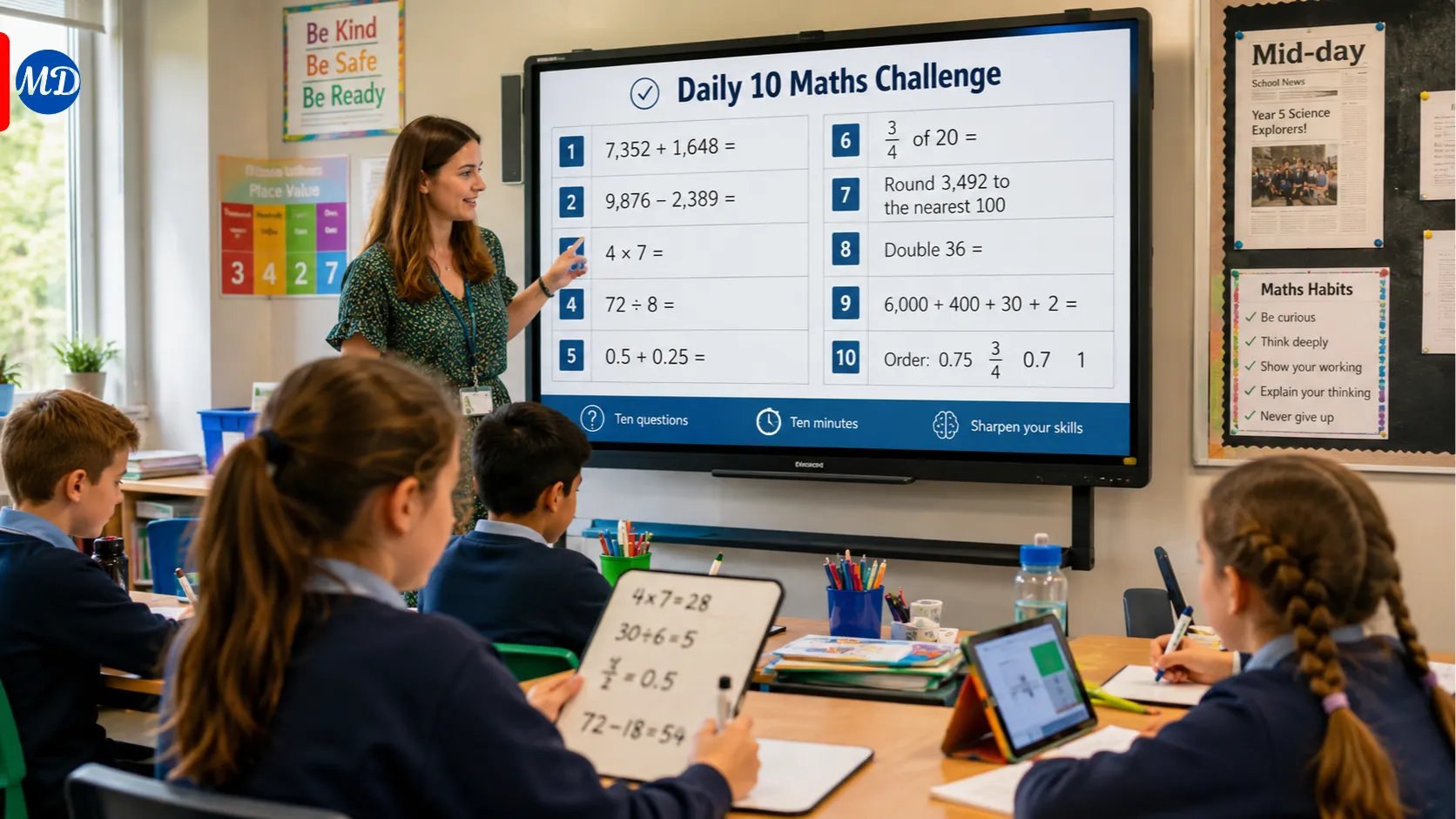
If you have searched for “Daily 10,” you are almost certainly looking for the free mental maths resource used in primary schools across the UK, created by Topmarks. It is one of those tools that has quietly become a staple of classroom life: a quick set of ten random maths questions, displayed on a whiteboard or screen, designed to sharpen calculation skills in a few minutes a day.
This guide explains exactly what Daily 10 is, how it works, how teachers and parents actually use it well, and how to get the most value from it, whether you are running a classroom starter activity or helping a child practise at home.
Daily 10 is a free primary maths resource created by Topmarks, a UK-based educational website. It generates ten random mental maths questions covering addition, subtraction, multiplication, division, ordering, partitioning, digit values, place value, rounding, doubling, halving, and fractions.
The tool was built specifically for primary teachers and is designed to be displayed on an interactive whiteboard, tablet, or any classroom screen. Questions are graded into levels that correspond to the year group expectations set out in England’s National Curriculum for Maths, making the resource suitable for children roughly aged 5 to 11, covering Years 1 through 6.
According to Topmarks’ own announcement when the resource launched, it was created due to popular demand from teachers, and was specifically designed to be tablet-friendly while also working well on an interactive whiteboard for starter or plenary sessions.
Each Daily 10 session presents ten maths questions, generated randomly so that the set is different every time. This randomisation is a deliberate design choice: it stops children from memorising a fixed sequence of answers and ensures the activity remains a genuine test of mental calculation rather than recall of a specific pattern.
Questions can be stepped through manually by the teacher, or displayed automatically at a set, configurable time interval. This flexibility allows the same resource to work for a fast-paced timed challenge or a slower, more considered pace where children have longer to think through each calculation.
At the end of a set of ten questions, answers can be revealed either all at once or one at a time, depending on how the teacher wants to review the session with the class.
Daily 10 is organised into levels that are matched to year group expectations under England’s National Curriculum. This means a Year 1 class and a Year 6 class can both use the same tool, but with the difficulty automatically adjusted to match what is age-appropriate for each group.
This levelling system is one of the resource’s most useful features for teachers managing mixed-attainment classes, since the same basic activity structure can be used across different ability groups simply by selecting a different level.
The full range of topics covered includes:
Teachers can typically select which topic area they want to focus a session on, rather than always getting a fully mixed set, which makes Daily 10 useful for targeted practice on a specific area the class is currently working on.
The most common classroom use of Daily 10 is as a short warm-up at the start of a maths lesson, or as a plenary activity to close one. Because the activity only takes a few minutes, it fits naturally into the structure of a typical primary maths lesson without eating into the time needed for the main teaching content.
Because the difficulty level can be adjusted, Daily 10 works well in classes where children are working at different stages. A teacher can run the same basic activity with different groups set to different levels, or use it as a light-touch way to gauge where individual children are struggling.
Beyond pure practice, Daily 10 can give a teacher a quick read on which mental maths skills need more attention across the class. If a significant number of children get the same type of question wrong, that signals an area worth revisiting in the next lesson.
One practical technique recommended by education specialists is to follow a Daily 10 session with a short discussion step. After completing a set of questions, asking children to explain one answer using a sentence stem such as “I know this because” shifts the activity from pure speed and recall toward mathematical reasoning and verbal explanation. This small addition helps the activity build genuine understanding alongside calculation fluency.
Topmarks offers a range of maths games, and Daily 10 is often used alongside another popular resource called Hit the Button. Understanding the difference between them helps clarify when to use each one.
| Feature | Daily 10 | Hit the Button |
|---|---|---|
| Format | Ten questions per session, teacher-paced or timed | Continuous quick-fire questions against the clock |
| Best for | Mixed-attainment classes, light-touch assessment, varied topic coverage | Rapid recall of number bonds, times tables, and division facts |
| Teacher control | High: choice of level, timing, and topic | Lower: focused on speed and specific fact families |
| Pacing | Can be slowed down for discussion and reasoning | Fast-paced, built for quick recall under time pressure |
Hit the Button is strongest when the specific goal is the rapid recall of facts like times tables. Daily 10 is the better choice when a teacher wants more control over level, timing, and question type, particularly for classes with a wide range of ability or when the goal includes some reasoning discussion alongside the calculation practice.
Daily 10 is not restricted to classroom use. The resource is freely accessible online and works on tablets and home computers, which makes it a practical option for parents looking to support maths practice outside school.
Because each session only takes a few minutes, Daily 10 fits easily into normal after-school routines without feeling like an extension of homework. The randomised questions also mean that repeated use does not become repetitive in a way that causes children to disengage.
One genuine benefit of a structured tool like this is that it does not require the supervising adult to be confident in maths themselves. Since the resource generates the questions and can reveal the answers, a parent does not need deep subject knowledge to use it effectively with their child.
Some children, and some learning situations, are better suited to written rather than on-screen practice. For families who prefer this, printable mental maths worksheets that mirror the same kind of question types as Daily 10 are a reasonable alternative or supplement, particularly for children who benefit from writing out their working for harder calculations.
A few observations explain why this particular resource has remained a staple in UK primary classrooms for years, well beyond a typical educational app’s lifespan.
Simplicity is the actual feature, not a limitation. Daily 10 does not have elaborate graphics, characters, or gamified reward systems. This is intentional, and it works in its favour for the specific purpose it serves. A clean, single-focus interface reduces distraction, which matters particularly for younger learners or for activities meant to be short and high-frequency rather than long and immersive.
Randomisation prevents a common weakness in repeated drills. Many mental maths tools risk children memorising a fixed sequence of questions rather than genuinely practising calculation. By generating a new random set each time, Daily 10 avoids this problem and keeps the activity a genuine test of skill rather than memory.
Curriculum alignment gives teachers confidence in level selection. Because the difficulty levels are mapped directly to England’s National Curriculum year group expectations, teachers do not need to guess whether a given level is appropriate. This reduces the planning burden of finding age-appropriate practice material.
The tool works best as part of a routine, not a one-off activity. The name itself, Daily 10, signals the intended use case: short, frequent, low-stakes practice repeated regularly. Mental maths fluency, like most skills, develops through consistent short practice rather than occasional long sessions, and the tool’s design reflects that principle directly.
Using a level that does not match the learner’s actual ability. Selecting a level based purely on year group rather than a child’s current skill level can make a session either too easy to be useful or too difficult to be encouraging. It is worth adjusting the level based on observed performance rather than rigidly following the assigned year group level.
Treating it purely as a speed drill with no follow-up discussion. Daily 10 builds calculation fluency well on its own, but pairing it with a brief explanation step, asking a child or class to explain their reasoning on one question, adds a layer of mathematical understanding that pure speed practice does not provide.
Running it too infrequently to build a habit. The benefit of Daily 10 comes substantially from regular, short repetition. Using it sporadically, once every few weeks, does not build the same fluency as a consistent daily or near-daily routine.
Ignoring topic-specific practice in favour of always using a mixed set. While general mixed practice has value, targeting a specific weak area, such as place value or fractions, using the topic selection feature can be more effective when a known gap exists in a child’s understanding.
Assuming the resource replaces written method instruction. Topmarks itself has noted that although Daily 10 is primarily a mental maths resource, teachers may prefer to allow children to use written methods for harder calculations. The tool is not designed to fully replace the teaching of written calculation strategies for more complex problems.
Daily 10 has remained a trusted part of UK primary maths teaching for years because it solves a genuinely practical problem simply and well: giving teachers and parents a quick, curriculum-aligned way to build mental maths fluency without complicated setup or planning. Its randomised questions, adjustable difficulty levels, and flexible pacing make it useful across a wide range of classroom and home situations, from a two-minute lesson starter to a slower, discussion-based session focused on reasoning.
Used consistently, and paired with the kind of follow-up discussion that pushes beyond pure speed, Daily 10 can do exactly what its name promises: build steady, lasting improvement in mental maths through a small amount of focused practice each day.
What is Daily 10? Daily 10 is a free mental maths resource created by Topmarks for UK primary teachers and parents. It generates ten random maths questions covering topics such as addition, subtraction, multiplication, division, place value, rounding, and fractions, with difficulty levels matched to England’s National Curriculum year groups.
Who created Daily 10? Daily 10 was created by Topmarks, a UK-based educational website that provides free games, worksheets, and interactive resources for primary-age children.
What age group is Daily 10 designed for? Daily 10 is designed for children aged 5 to 11, covering Years 1 through 6 under England’s National Curriculum for Maths.
Is Daily 10 free to use? Yes. Daily 10 is a free resource available on the Topmarks website, with no login or payment required to access it.
How is Daily 10 different from Hit the Button? Daily 10 gives teachers more control over level, timing, and question type, making it useful for mixed-attainment classes and varied topic practice. Hit the Button is focused on rapid, quick-fire recall of number bonds, times tables, and division facts, making it stronger for pure speed-based fact recall.
Can Daily 10 be used at home? Yes. Daily 10 works on tablets and home computers as well as classroom interactive whiteboards, making it accessible for parents to use with children outside of school.
What topics does Daily 10 cover? Daily 10 covers addition, subtraction, multiplication, division, ordering, partitioning, digit values, place value, rounding, doubling, halving, and fractions.
How long does a Daily 10 session take? A typical session involves ten questions and can take anywhere from a few minutes, if timed quickly, to longer if used at a slower pace with discussion of answers. Most classroom uses fit within a five to ten-minute window.
Can Daily 10 be used for assessment? Daily 10 is primarily a practice tool, but teachers often use it as a light-touch way to gauge which mental maths skills need more attention, based on which questions a class struggles with most.
Does Daily 10 replace teaching written calculation methods? No. Daily 10 is designed primarily for mental maths practice. Teachers are generally encouraged to still allow and teach written methods for harder calculations, since the tool focuses on mental fluency rather than full calculation strategy instruction.





[…] guide covers everything schools, SENCOs, and parents need to know about Literacy Gold: what it is, what it does, how it works in […]
[…] Read More: Daily 10: The Complete Guide to the Topmarks Maths Tool […]