Physical Address
304 North Cardinal St.
Dorchester Center, MA 02124
Physical Address
304 North Cardinal St.
Dorchester Center, MA 02124

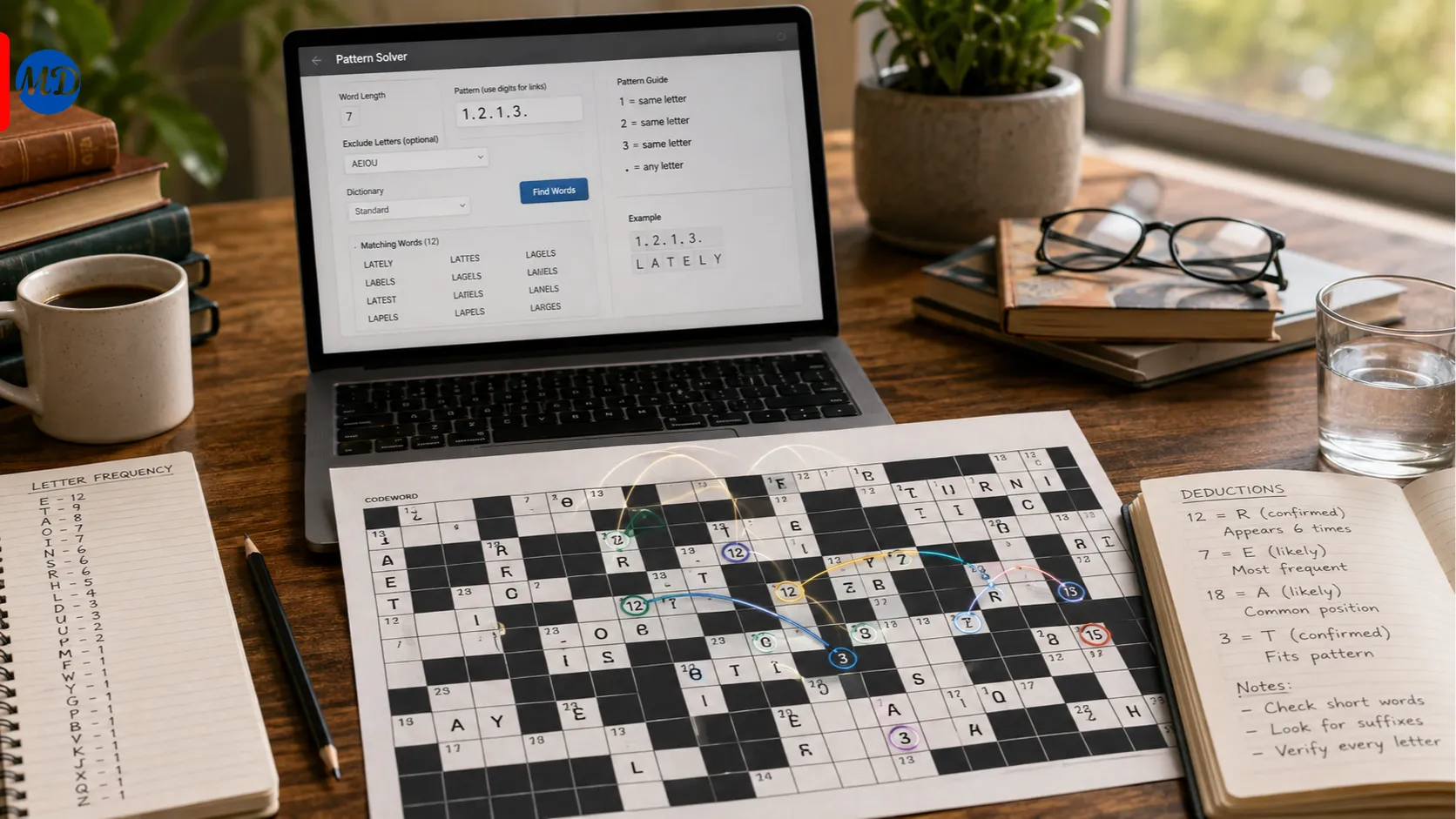
Stuck on a codeword puzzle? You are not alone. Codewords are one of the most popular word puzzle formats in British newspapers and puzzle magazines, and they are genuinely different from crosswords. When you hit a wall, and no amount of staring at the grid helps, a codeword solver is the right tool. But most people do not know how these solvers actually work, what makes them different from crossword solvers, or how to use them efficiently.
This guide covers all of it: what a codeword puzzle is, how a codeword solver works under the hood, how to use one properly, which strategies help you before you even reach for a solver, and the common mistakes that waste your time.
A codeword puzzle, also called a code-cracker or codecracker, is a crossword-shaped grid where every letter has been replaced by a number from 1 to 26. There are no word clues. Instead, the puzzle gives you a small set of pre-revealed letter-number pairs as starting anchors, and your job is to use logical deduction to decode the rest.
The defining rule is this: each number always represents the same letter throughout the entire grid, and each letter is represented by exactly one number. No number maps to two letters. No letter maps to two numbers.
This rule is what makes the puzzle solvable. Once you decode number 12 as the letter R, every square in the grid labelled 12 becomes R instantly. Each confirmed assignment ripples outward and unlocks other words, creating a chain of deductions that eventually fills the grid.
Codewords appear regularly in publications such as The Daily Mail, The Daily Telegraph, The Times, and numerous dedicated puzzle magazines published by companies like Puzzler Media. They are also widely available on puzzle websites and mobile apps.
A codeword solver is an online tool or application designed specifically to find words that match the constraints of a codeword puzzle. You enter what you know about a word, including its length, any letters you have already decoded, and crucially,y which positions in the word share the same unknown letter, and the solver returns every dictionary word that satisfies all those constraints simultaneously.
The key phrase is “simultaneously.” A codeword solver is not simply a dictionary lookup. It enforces the linked-letter constraint that is unique to codeword puzzles, something that general crossword solvers and anagram tools do not do.
This distinction matters enormously in practice, and it is the most misunderstood aspect of codeword tools.
A crossword solver matches a pattern to a dictionary,ry where each unknown position is treated as independent. If you enter a six-letter word starting with S and ending with E, it returns every six-letter word with those letters in those positions. It has no concept of linked positions.
In a codeword, positions are not independent. If the number 7 appears in positions 2 and 5 of a word, those two positions must contain the same letter. A crossword solver cannot enforce this. It will return words where position 2 and position 5 are different letters, leaving you to filter manually through a potentially long list.
A purpose-built codeword solver enforces the linked-letter constraint in a single pass. You describe the pattern using digits for linked positions and dots or underscores for unconstrained unknowns. The solver returns only words where every rule you described is already satisfied. There is no manual filtering needed.
Anagram tools are similarly unsuitable. They rearrange a complete set of letters you already have. In a codeword, you typically know some positional information and some letter links, but you do not have all the letters. That is the inverse of what an anagram tool handles.
Understanding the mechanics helps you use the tool more accurately.
When you submit a pattern, the solver searches its dictionary and returns every word satisfying your constraints. The process is deterministic: given the same pattern and the same dictionary, the same results appear every time.
A pattern contains three types of characters:
A well-built solver enforces all three constraint types in one operation. For example, a pattern like “1 1 . E” describes a four-letter word where positions 1 and 2 are the same letter, position 3 is unconstrained, and position 4 is the letter E. Only words satisfying every rule appear in the results.
Most dedicated codeword solvers offer multiple dictionary tiers. A typical structure includes:
For most newspaper codewords, the standard dictionary tier is the right starting point. The expanded tier is useful when a word you expect does not appear at the standard level, but it can also return obscure results that are unlikely to appear in a mainstream puzzle.
Some advanced codeword solvers offer a two-pattern or multi-pattern mode. This is particularly useful when two words in your grid intersect or cross, sharing a decoded letter. Instead of finding all candidates for word A and manually checking them against all candidates for word B, the solver finds only word combinations where both words satisfy their individual constraints and the shared letter matches consistently. This can reduce a large list of candidates to a handful in one step.
Here is a practical walkthrough for a single-word search.
Step 1: Identify what you know about the target word. Count the word’s length. Note any letters you have already decoded from elsewhere in the grid and their exact positions. Identify which numbered positions appear more than once within the word, since those positions must share a letter.
Step 2: Build your pattern. Enter known letters in their correct positions. Use a dot or underscore for unconstrained unknowns. Use the same digit for any two positions that carry the same grid number. Use different digits for positions that carry different grid numbers.
For example: a seven-letter word where you know the first letter is C, the third letter is T, and positions 4 and 7 share the same unknown number. Your pattern might be entered as. T 1 . 1″.
Step 3: Add exclusions if available. Most solvers include a “Remove” or “Exclude” field where you can enter letters you know are already assigned to other numbers. If you know that A is number 3 and R is number 11, you can exclude both A and R from appearing in positions where you are using a wildcard. This narrows the results significantly.
Step 4: Choose your dictionary tier. Start with the standard tier. If it returns nothing useful, try the expanded dictionary. If results are too numerous, add more known letters or tighten your exclusions.
Step 5: Review results with grid logic. Do not simply pick the first word returned. Check each candidate against the rest of your grid. Every time a candidate assigns a letter to a number, verify that the assignment is consistent with every other word in the grid containing that same number.
A solver is most useful as a narrowing tool, not a replacement for logical deduction. Knowing the underlying strategies makes you faster at both manual solving and using a solver more precisely.
Every codeword provides two to five starter letters. These are deliberately chosen to give you a way into the puzzle without making it trivial. Write them in immediately across the full grid. Any word that contains one of those numbers becomes partially revealed, and you can sometimes spot familiar words or patterns right away.
In standard English, the most common letters are E, T, A, O, I, N, S, H, and R. The number that appears most frequently across the entire grid is very likely to be E, since E is the most common letter in English text. The next most frequent numbers are strong candidates for T and A.
This is not a guarantee, since puzzle setters are aware of this technique and design puzzles accordingly, but frequency analysis gives you a useful starting hypothesis when you are making early guesses.
Two- and three-letter words are powerful deduction anchors. The number of valid two-letter English words is small. If a two-letter word in your grid has one confirmed letter, there are only a handful of words it could be. Confirming that word can unlock several letters at once.
Pay attention to common English word endings such as -ING, -ED, -ER, -LY, -TION, and -NESS. Common prefixes like RE-, UN-, IN-, and PRE- are also frequent. When a word already has two or three confirmed letters near the end, checking whether they fit a familiar suffix pattern can narrow your options quickly.
Every time you assign a letter to a number, immediately check that assignment against every other word in the grid that contains the same number. One wrong early assumption compounds across the grid. If an assignment creates a word that looks impossible (starting with two consonants that never co-occur in English, for example), revisit the assumption before going further.
Most codeword puzzle pages include a small reference box listing all 26 letters and all 26 numbers. Cross off each letter and number as you decode them. This prevents accidentally assigning two numbers to the same letter, which is one of the most common errors in manual solving.
A few observations from experienced codeword solvers that rarely appear in beginner guides:
The starter letters are not your most frequent letters. Puzzle setters intentionally avoid including E, T, or A among the given starters, because revealing those letters would make the puzzle too easy too quickly. When you receive starters, assume they represent mid-frequency or less common letters.
A word that looks forced is a warning signal. Codeword puzzles in reputable publications are built around accessible vocabulary. If your current letter assignments produce a word that looks highly obscure or implausible, the problem is almost certainly an incorrect earlier assignment, not genuinely rare vocabulary.
Repeated letters within a single word are unusually helpful. Words with double letters, or with the same letter in multiple positions, are easy to spot because the same number appears twice in the same word. This gives you strong constraints and can confirm an assignment with high confidence.
The Remove field is underused. Many solvers provide a field to exclude letters you have already confirmed elsewhere in the grid. Entering six or eight known letters here can reduce a list of 40 potential matches to three or four, making the decision obvious.
Committing to an assumption too early. It is tempting to assign a letter as soon as one possibility seems likely. Unless you have confirmed it through multiple words, treat it as a hypothesis and keep alternatives in mind.
Using a crossword solver instead of a codeword solver. A crossword solver will return many words that technically fit the letter positions but violate the linked-number constraints. The extra filtering you have to do manually defeats the purpose of using a tool at all.
Searching with too few constraints. Entering a pattern like “. . . . .” for a five-letter word with nothing known will return hundreds of results. Add every piece of information you genuinely have before searching: known letters, exclusions from other decoded words, and linked-digit relationships.
Ignoring cross-checks after using the solver. The solver returns every word satisfying your pattern. It does not know the rest of your grid. You still need to verify that the letter assignments a candidate word implies are consistent everywhere else.
Starting with rare letters. If you are making an educated guess about an unconstrained number, guessing Q, Z, X, or J is almost always wrong for early-grid numbers. These letters appear rarely in English text and are typically assigned to numbers that appear infrequently across the grid.
For beginners:
For regular solvers looking to improve:
A codeword solver is a focused, specialised tool. Its core value is enforcing the linked-letter constraint that is unique to codeword puzzles, something a general crossword solver or anagram tool simply cannot do. Used well, it takes a word where you have partial information and a few linked positions and returns a tight list of candidates that satisfy every rule you have described.
The best approach combines both manual deduction and the solver strategically. Frequency analysis, short-word anchoring, pattern recognition, and careful cross-checking will get you through most of a puzzle. The solver handles the moments where the logic runs out, and you need to see which words are genuinely possible given your current state of knowledge.
When you know what kind of tool you need and how to feed it accurate information, codeword puzzles stop being frustrating and start being the satisfying logical challenge they are designed to be.
What is a codeword solver? A codeword solver is an online tool that finds dictionary words matching a specific codeword pattern. You enter known letters, wildcard positions, and linked-position constraints using digits, and the solver returns every valid word that satisfies all those rules simultaneously.
How is a codeword solver different from a crossword solver? A crossword solver treats each unknown letter position as independent. A codeword solver enforces the linked-letter constraint, meaning positions that share the same number in the puzzle must resolve to the same letter. Crossword solvers cannot enforce this, so they return many results that would violate codeword rules and require manual filtering.
What is the best way to enter a pattern into a codeword solver? Use actual letters for positions you have decoded, dots or underscores for unconstrained unknowns, and matching digits for positions that share a codeword number. Add confirmed letters you have decoded elsewhere in the grid to the exclusion or Remove field to narrow the results.
Should I use the standard or expanded dictionary tier? Start with the standard dictionary for newspaper and magazine codewords. Only switch to the expanded dictionary if the standard tier returns nothing relevant. Expanded dictionaries include rare and obscure words that are unlikely to appear in mainstream publications, which can make results less useful.
Can a codeword solver solve the entire puzzle automatically? Most codeword solvers are designed to help with individual words within the grid, not to solve the entire puzzle automatically. You still need to work through the grid logically, using the solver to find candidates for specific words when manual deduction stalls.
What is the most common mistake when using a codeword solver? Entering incomplete or inaccurate patterns. If you omit linked-digit relationships or forget to exclude already-decoded letters, the solver returns a much longer list than necessary. The more accurate and complete your input, the more useful the results.
What do the letters E, T, and A have to do with codeword solving? E, T, and A are the three most common letters in English text. The number that appears most frequently across a codeword grid is likely to be E. This frequency analysis technique gives you a starting hypothesis for early guesses when the starter letters alone are not enough to progress.
Is using a codeword solver considered cheating? This is entirely a personal decision. Codeword solvers are widely available and openly promoted alongside puzzle content. Many experienced solvers use them as a final step when genuinely stuck, rather than for every word. Some people prefer to solve without any assistance for the full cognitive challenge.
Where can I find a codeword solver? Several free code solvers are available online. Dedicated options built specifically for codeword logic include codewordsolver.co.uk and codewordsolver.uk. Danny Brien’s tool at dannybrien.com offers a straightforward alternative. Always look for a solver that explicitly enforces the linked-letter constraint rather than a general pattern matcher.
What are the rules of a codeword puzzle? Each number from 1 to 26 represents exactly one letter of the alphabet. Each letter maps to exactly one number. Every number must appear in the grid at least once. You are given a small number of pre-revealed letter-number pairs as starting points. The grid must be filled so that every word reads as valid English.