Physical Address
304 North Cardinal St.
Dorchester Center, MA 02124
Physical Address
304 North Cardinal St.
Dorchester Center, MA 02124

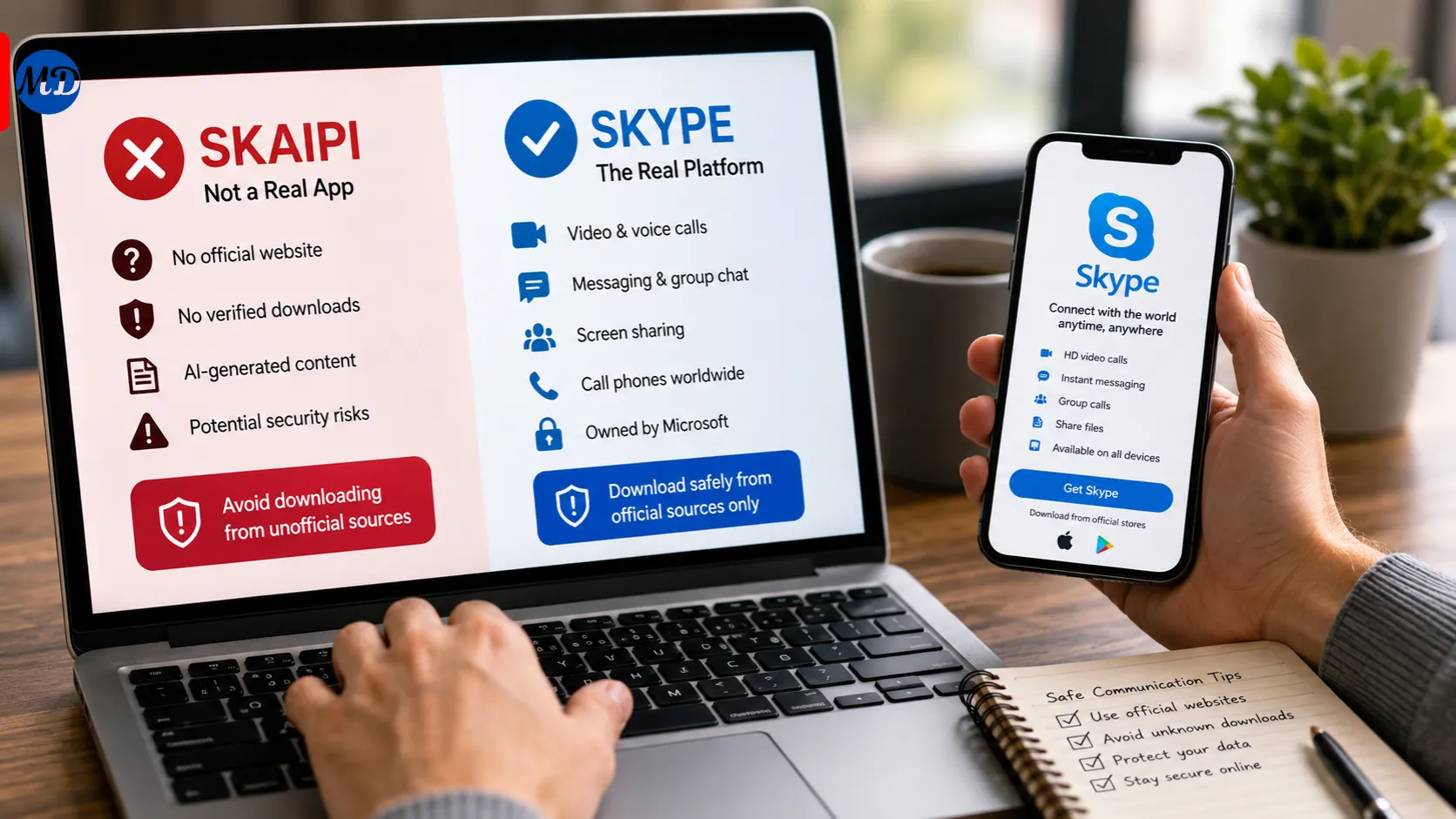
If you searched for “skaipi” and found yourself reading about a revolutionary new communication app with AI features and enterprise-grade tools, you were likely looking at content that does not reflect reality. The truth about this keyword is more interesting and more important for your safety than most search results suggest.
This article explains what Skaipi actually means, why it appears in search engines, and what you should know before clicking any link that promises to let you download or use it.
Skaipi is not an officially named app, platform, or software product. No company called Skaipi exists. No verified download is available from a trusted source under this name.
In most cases, “skaipi” is a phonetic spelling of Skype, the well-known video calling and messaging service owned by Microsoft. In many languages and regions where English is not the primary language, people write words based on how they sound when spoken aloud. The word “Skype” is pronounced roughly as “skaip,” and adding the letter “i” at the end reflects a natural adaptation to pronunciation patterns in languages such as Hindi, Georgian, Arabic, and others.
This linguistic variation is very common online. Speakers of dozens of languages search for communication tools using the sounds of words they have heard, not the official English spelling. Search engines pick up these phonetic variations as separate keywords, and that traffic then attracts content farms and low-quality websites.
There are two main reasons this keyword generates search activity.
First, phonetic spelling across languages. When someone hears “Skype” spoken aloud and tries to search for it, they may type “skaipi,” “skaype,” “scaipi,” or similar variations depending on their native language’s spelling conventions. This is especially common in South Asia, Eastern Europe, the Middle East, and parts of Africa, where Skype has had long-term popularity for low-cost international calls.
Second, AI-generated spam content. Starting around 2025 and into 2026, a significant number of websites began publishing articles describing “skaipi” as if it were a real, independent communication platform. These articles typically describe features like encrypted messaging, HD video calls, cross-platform support, file sharing, and team collaboration tools. The descriptions are almost identical across dozens of different domains, which is a strong indicator of automatically generated or copy-pasted content rather than original reporting on a genuine product.
One analysis of this content landscape noted that descriptions appearing on multiple sites were word-for-word the same, which is a clear sign of AI-generated or spam content rather than coverage of a real product.
Since the search intent behind Skype almost always points toward Skype, it is worth understanding what Skype actually is and who owns it.
Skype is a telecommunications application developed originally by Estonian developers Ahti Heinla, Priit Kasesalu, and Jaan Tallinn, and launched in 2003. Microsoft acquired Skype in 2011 for approximately 8.5 billion US dollars. Today, Skype is a product of Microsoft Corporation and is available as a free download on Windows, macOS, iOS, Android, and through a web browser.
Skype provides the following core features to registered users:
Skype is free to download and use for calls between Skype accounts. Calling actual phone numbers requires Skype Credit or a subscription plan.
If you are looking for a video calling app and searched for “Skype,” the safe and correct step is to download Skype directly from Microsoft’s official website at Skype.com or from the official Apple App Store or Google Play Store. Never download communication software from unfamiliar third-party websites, as these may contain malware or collect personal data without consent.
Many websites ranking for the keyword “skaipi” describe a product that does not appear to exist in any verifiable form. These articles share several warning signs that are worth recognizing.
When different websites use nearly identical sentences to describe “Skaipi’s” features, that is a strong signal that the content was generated automatically and published across multiple domains for traffic purposes. Legitimate technology products are covered by independent journalists, reviewed by real users, and documented by the company itself in official channels.
No official Skaipi website, verified company profile, press release, or app store listing exists under the name “Skaipi” from a named, traceable developer.
Some content claiming to cover Skaipi cites statistics such as “a 25% reduction in meeting times” attributed to research firms. These figures are not traceable to published studies. Citing unverifiable research statistics is a hallmark of low-quality or fabricated content.
Descriptions of “Skaipi” features tend to be generic: encrypted messaging, HD video, file sharing, and cross-platform support. These are standard features of dozens of real platforms. No unique or verifiable technical detail distinguishes the claimed product from existing apps like Skype, Zoom, Microsoft Teams, or WhatsApp.
As of mid-2026, no officially registered, publicly verifiable software product or company operates under the name “Skaipi.” No listing exists in major app stores under this exact name from a credible developer. No company website, registered trademark, or documented founder is publicly associated with the name.
If this changes in the future and a legitimate product launches under the Skaipi name, it would be documented in official app stores, announced by named developers, and covered by established technology media.
Until that is the case, any website describing Skaipi as a fully functional, available platform should be treated with significant skepticism.
The pattern around “skaipi” is a useful example of a broader problem: low-quality or AI-generated content designed to capture search traffic by creating the appearance of covering a real product. These sites often serve several purposes:
If you land on a page describing Skaipi as a real app and are prompted to download software, enter personal information, or pay for access, you should close the page and go directly to a known, trusted source instead.
For video calling needs, established and verifiable options include Skype (microsoft.com/skype), Zoom (zoom.us), Microsoft Teams (microsoft.com/microsoft-teams), Google Meet (meet.google.com), and WhatsApp (whatsapp.com).
Misconception 1: Skaipi is a new competitor to Skype or Zoom. There is no evidence of any legitimate company launching a product under this name. The claim appears to originate from AI-generated content websites.
Misconception 2: Skaipi has unique AI features not found in other apps. Claims about AI-powered features, context-aware connectivity, or AR integrations in “Skaipi” are not supported by any verifiable product documentation, app store listing, or independent review.
Misconception 3: Searching for Skaipi is dangerous. The search itself is not harmful. The risk comes from clicking through to sites that make exaggerated claims or prompt downloads. Searching is safe; downloading software from unverified sources is not.
Misconception 4: Skaipi is a regional name for Skype in some countries. While “skaipi” functions as a phonetic approximation of “Skype” in certain languages, Skype itself does not use or endorse this spelling. The official name and branding remain “Skype” across all markets.
If you searched for “Skype because you want a reliable tool for video calls, messaging, or team collaboration, the following guidance applies depending on your needs.
For personal video and voice calls: Skype remains a well-established free option for calls between users, with paid options for calling phones. WhatsApp is widely used for mobile calling and messaging globally and is free for device-to-device communication.
For team collaboration at work, Microsoft Teams and Slack are the two most widely adopted workplace communication platforms. Both offer free tiers and paid plans with expanded features.
For video meetings: Zoom and Google Meet are the dominant options for scheduled video meetings, both offering free plans with time-limited meetings for non-paying users.
For users in regions with limited connectivity, WhatsApp’s voice call feature is optimized for lower bandwidth environments and is particularly popular across South Asia, Africa, Latin America, and the Middle East.
The “skaipi” keyword illustrates several things happening simultaneously in the online information environment.
Search engines are improving, but still struggle with auto-generated spam content at scale. Dozens of low-quality articles about a non-existent product can rank for a trending keyword because they use correct on-page SEO signals even without genuine underlying value.
Users in multilingual contexts are often underserved. When someone in a country where English is a second language searches for a tool they heard about verbally, they may not find accurate, native-language information easily. This creates an opening that content farms exploit.
The proliferation of AI text generation has made it easier to produce large volumes of plausible-sounding content about topics that do not warrant coverage. Recognizing the warning signs, identical wording across sites, unverifiable statistics, unnamed developers, and no official app store presence is a useful skill for any online reader.
Skaipi is not a verified app or platform. It is, in most cases, a phonetic spelling of Skype used by people in non-English-speaking regions, and it has become a keyword that attracts low-quality auto-generated content across many websites.
Understanding this distinction protects you from wasting time on content that does not reflect a real product and from the risk of downloading software from unreliable sources. If you need a communication tool, the reliable options are well-documented, widely available, and free to download from official sources.
The most useful thing this article can tell you is the truth: no product called Skaipi exists in verified form, and Skype remains the most likely intended search behind this keyword.
What is skSkaipiSkaipi is not a real, independently verified app or platform. In most cases, it is a phonetic spelling of Skype, the Microsoft-owned video calling service. Some AI-generated websites describe it as a communication platform, but no official product by this name has been verified in any app store or by any named developer.
Is Skype the same as Skypehey? They are not the same thing in name or branding. “Skaipi” appears to be a phonetic adaptation of how “Skype” sounds when spoken aloud, commonly used in regions where English is not the primary language. Skype itself is a Microsoft product with a distinct official name.
Is sSkaipisafe to download? There is no verified, official version of an app called Skaipi available for download. Any site offering a Skaipi download should be treated with caution. Download communication apps only from official sources such as the Apple App Store, Google Play Store, or the official Microsoft website.
Why do so many websites describe Skaipi as a real platform? Many of these sites publish AI-generated or auto-created content to attract search traffic on trending keywords. The descriptions are typically generic, often identical across multiple sites, and not backed by any verifiable product documentation. This is a recognized pattern of low-quality content farming.
What should I use instead of Skaipi? If you want video calls, use Skype, Zoom, Google Meet, or WhatsApp. For team communication, Microsoft Teams or Slack are the leading verified platforms. All of these are available as free downloads from official sources.
Why does Skaipi show up in search results if it is not real? Search engines index content based on relevance signals, not always on whether the subject of an article actually exists. When many websites publish similar content about the same keyword, search engines may surface those results even if the underlying content is low quality or misleading.
Who owns Skype? Microsoft Corporation has owned Skype since 2011, when it acquired the company for approximately 8.5 billion US dollars. Skype is available at skype.com.
Can I use Skype for free? Yes. Skype-to-Skype calls, video calls, and messaging are free between registered users. Calling actual mobile or landline phone numbers requires Skype Credit or a subscription plan.